Public Capital Spending in Infrastructure: BOOST Program Measures
Capital spending represents a major share of expenditures for national and subnational governments, and a critical instrument to lift people out of poverty by promoting economic growth and improving access to basic services. The recognition of the critical role that well-designed and efficiently implemented investments in infrastructure can play in addressing these access gaps and fostering potential GDP gains is well documented (for example, Calderón and Servén 2010; Bom and Ligthart 2008; Calderon, Moral Benito, and Serven 2015). The relevance of the role of such investments is also reflected in the Sustainable Development Goals and International Development Association (IDA) 18 frameworks, which place a much needed emphasis on the need to significantly scale up investments in infrastructure for the positive, cross-cutting spillover effects they can generate in promoting shared prosperity and poverty alleviation.
Despite the consensus on the relevance of investing in infrastructure as an accelerator for long-term growth and poverty alleviation, there still exists very little knowledge about how much is being spent, how well, and with what results. This lack of information is particularly compelling in Sub-Saharan Africa, where infrastructure needs are most acute and the overall quality of fiscal statistics is problematic. Without a strong empirical baseline of current public spending in infrastructure and a robust set of granular data and performance metrics, it is difficult to: (a) identify which geographic areas and sectors are being underserved, (b) assess whether policy stances are being translated into actions, and (c) isolate critical bottlenecks that are undermining efficiency in public investment management systems across the developing world.
Leveraging the wealth of micro fiscal data collected by the BOOST initiative (box 2.6), this subsection offers a baseline of public spending on infrastructure in Africa. Using an initial sample of 24 countries in Sub-Saharan Africa for 2009 to 2015, the subsection examines overall annual trends, execution rates, funding sources, and levels of capital expenditure across infrastructure sectors, as well as the quality of their systems in producing high-quality data. Despite the preliminary nature of this work, and the need for further refinements in data quality and expansion to additional countries in the region, some important findings have already emerged. (See annex 2A on data challenges.)
| BOX 2.6: About the BOOST Initiative | The BOOSTa program is a World Bank collaborative effort that was launched in 2010 to provide quality access to budget data. The initiative strives to make well-classified and highly disaggregated budget data available for policy makers and practitioners in government, researchers, and civil society, and promote their effective use for improved budgetary decision making, analysis, transparency, and accountability. Since its launch, the program has centered its activities around three work streams: (a) supporting expenditure analysis, (b) advancing fiscal transparency and public dissemination of budget data, and (c) improving public financial management processes and systems. |
| |
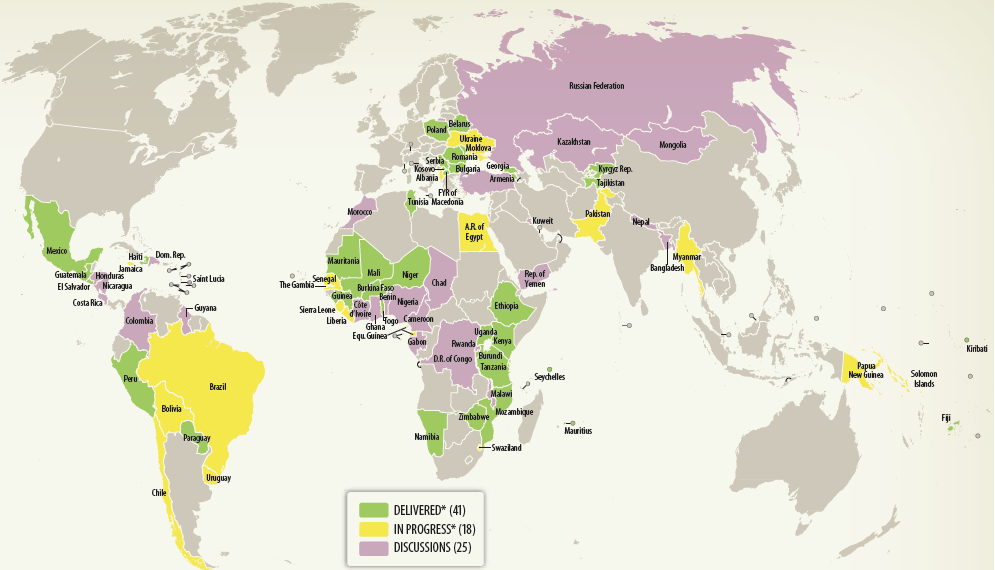
| *Note: Delivered includes three state level BOOSTS in the Brazilian States of Rio Grande do Sul, Minas Geiras and Sao Paulo. In progress includes Rio de Janeiro | |||
| Using the government's data from public expenditure accounts held in the governments 'financial management information systems, and benefiting from a consistent methodology, the program transforms highly granular fiscal data into accessible and readily available formats to facilitate expenditure analysis. The program has designed and delivered more than 60 national and subnational BOOST data sets in standardized formats, whose contents are country specific. Each data set typically allows for approved, revised, and executed budgets to be cross-referenced across years with categories such as: • Government levels (central or local) • Administrative units (ministries, departments, agencies, schools, hospitals, and so forth) • Subnational authorities (districts, municipalities, and other local government units) • Economic classification categories (staff salaries, procurement of goods, and so forth) • Sources of funding (budget funds, off-budget funds, external finance, and so forth) • Budget programs (if the country uses a program-based budgeting system). An expanding work stream of the BOOST program focuses on providing support for government efforts around fiscal transparency and citizen participation in the budget process. To this end, the program facilitated the dissemination of country BOOST data sets via (a) the World Bank's Open Budgets Portal, which has already witnessed the release of more than 40 million line items of expenditure data, and (b) development of country-owned web portals, such as in the cases of Burundi, Haiti, Paraguay, Togo, and Tunisia. The Open Budgets Portal is the largest repository of micro fiscal data in the world, offering invaluable resources for stakeholders involved in the systematic use of fiscal data in their countries or globally, as a catalyst to motivate other countries into action. The portal is accessible at www.worldbank.org/openbudgets. a BOOST is not an acronym. It is the name of a new data tool developed at the World Bank to help enhance public sector performance. | |||