High Dependence on Foreign Aid Can Crowd Out Domestic Sources
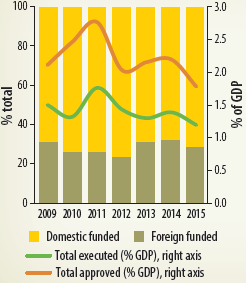
Foreign aid continues to play an important role in some of the infrastructure subsectors. Although the share of the overall capital budget allocations funded through external aid decreased from 39 percent in 2009 to 36 percent in 2015, the distribution of this change was different across sectors. Road transport is the sector with the greatest share of domestic contribution, with the foreign funded share steadily accounting for around 30 percent of total allocations (figure 2.38, panel a).
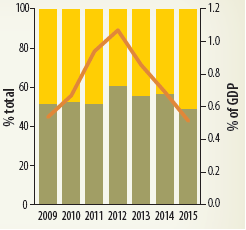
FIGURE 2.38: Evolution of Spending, Total and by Source, 2009-15 | ||
a. Roads
| b. Electricity
| c. Water
|
Source: World Bank, BOOST data, staff calculations. |
| |
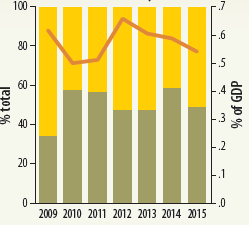

For electricity, there has been a substantial increase in foreign funded projects, driven mainly by the infrastructure push embedded in the "Power Africa" initiative (figure 2.38, panel b). Uganda, Angola, Kenya, and Burkina Faso are among the countries in the sample that recorded the largest increases in foreign funded capital allocations in the sector. However, the data suggest that the increased reliance on foreign funding might be crowding out domestic spending in the sector, making it particularly vulnerable to sudden drops in aid volume (as experienced in 2015), as well as the unpredictability of funding that is typical of these interventions.
Capital spending in water and sanitation is also vulnerable to sudden drops in foreign assistance and crowding out of domestic capital. The significant decrease of foreign funds devoted to this sector since 2012-moving from 60 percent to less than 50 percent of the total-was the main driver behind a corresponding decrease in overall capital allocations by Sub-Saharan African countries in the sample, moving from 1 percent of GDP in 2012 to less than 0.5 percent in 2015 (figure 2.38, panel c). In Niger and Benin, for instance, foreign assistance traditionally accounted for a major share of total capital allocations. When foreign assistance was reduced in 2015, this generated a significant drop in overall capital allocations in the sector. Similar patterns were found in Mozambique, Tanzania, and Sierra Leone, although overall capital reductions were less significant. Given the strategic importance of improving the size and quality of public spending in the sector, it is imperative for African countries to reduce their exposure to and reliance on foreign aid, by striving to reach a better balance of funding sources for the sector toward greater domestic mobilization.