Under-Execution Affects the Efficiency of Public Investment
Analyzing the under-execution of public investment is important for assessing the magnitude of efficiency losses, and examining the underlying determinants of these inefficiencies. This analysis focuses on the difference between what was originally approved versus what was actually spent in any given year. Focusing on the deviations from original approved budgets (rather than mid-year supplementary budgets) enables the assessment of the level of credibility built into approved capital budgets. Given the uneven availability of spending of foreign funded aid, the analysis relies on examining the deviation between capital allocations and execution of domestic funded projects. This provides a better assessment of the ability of national systems to implement capital projects.
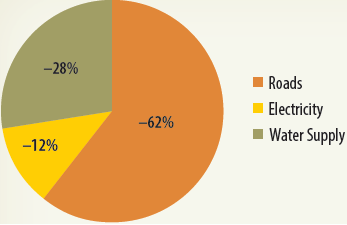
The Sub-Saharan Africa region displays very large levels of under-execution. On average, over 30 percent of total domestic allocations was not executed annually from 2009 to 2015. This amounted to almost 1 percent of GDP per year remaining unspent on capital infrastructure. Roads account for two-thirds of the total underspending, well above underspending in electricity and water and sanitation (figure 2.39). This is particularly worrisome, since most of the domestic resources are mobilized toward roads, with capital spending on electricity and water and sanitation still dominated by foreign assistance.
Several factors account for these levels of under-execution. Historically, most African countries have taken a residual approach to capital spending, which often results in mid-year decreases in disbursement in typical scenarios of over-optimistic revenue projections leading to in-year prioritization toward recurrent expenses. Further drivers include late releases in countries without a proper medium-term capital commitment framework; implementation gaps due to absorptive capacity and other institutional bottlenecks (that is, inefficient procurement systems); and the pervasiveness of corruption and lack of accountability, leading to suboptimal delivery of infrastructure.
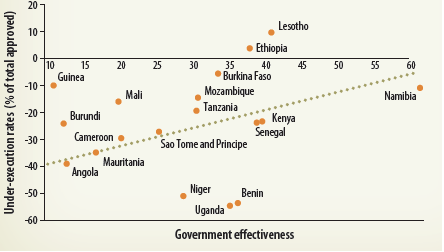
| Not surprisingly, our analysis revealed positive correlation between levels of under-execution of capital projects and levels of governance (that is, the WGI Government Effectiveness Index) (figure 2.40).This positive association confirms the hypothesis that issues of absorptive capacity and regulatory frameworks affect the ability of countries to execute annual capital allocations. | FIGURE 2.39: Drivers of Under-Execution in Capital Spending
Source: BOOST data, staff calculations. FIGURE 2.40: Under-Execution Rates in Domestic Funded Infrastructure, 2009-15
Source: BOOST data, staff calculations. | Execution of capital spending is a problem. Close to one-third of total domestic allocations were not executed annually from 2009 to 2015 in these three sectors. |