New Frontiers in Measurement and Analysis of Capital Spending on Infrastructure
One of the biggest challenges faced by many developing countries is understanding the factors hindering the implementation of public investment projects. The ability of public investment management systems to provide an accurate, integrated view of the project cycle is very weak, especially in low-capacity countries across Africa. In the few countries where the financial management systems capture individual project information, the data recorded are typically limited to that year's budget, allocation, and expenditure amounts.17
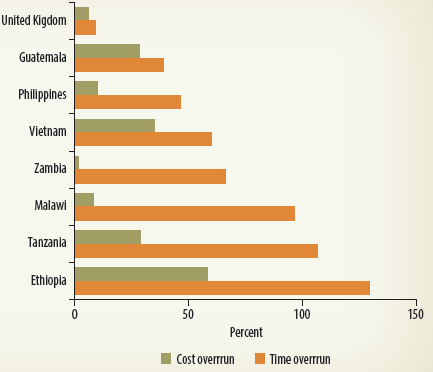
A recent study carried out by the Construction Sector Transparency Initiative-a multi-stakeholder initiative that seeks to promote transparency and accountability in public infrastructure-involved collecting data on the costs and quality of public projects during the preparation and construction phases in eight countries-including four countries in Sub-Saharan Africa (Ethiopia, Malawi, Tanzania, and Zambia) (figure 2.41). This simple analysis not only provides an important baseline for monitoring the evolution of performance indicators, but also emphasizes the importance of the ability of national financial management systems to produce these portfolio output visualizations on a routine basis.
| Data such as these collected to increase accountability in public infrastructure, are key for monitoring the evolution of performance indicators. | FIGURE 2.41: Cost and Time Overruns, CoST Baseline Sample
Source: Brumby and Kaiser (2013). | A further challenge centers on the adequacy of the operations and maintenance expenditures relative to existing public capita stock as well as projected capital expenditures. Underspending on operations leads to suboptimal levels of public capital stock depreciation, which reduces the lifespan of the asset. |
In this context, very few countries in Sub-Saharan Africa provide a precise distinction between pure capital expenditure-that is, gross capital formation-and the operational expenses of the investment. A best case scenario is represented by Namibia, which neatly distinguishes between the two categories, allowing for quick visualization of the ratio of gross capital formation versus related operational expenditures.
___________________________________________________________________________________________
17 More detailed data on each of the projects exists, but they are recorded only on spreadsheets and scattered among various departments and ministries.