Quality of the Institutional and Regulatory Framework for PPPs
A robust institutional and regulatory framework is critical in attracting private investment for infrastructure projects. Given the high costs and risks investors face, many criteria must be met, especially in Sub-Saharan Africa, where economic and financial conditions are often more tenuous. For example, there must be peace and stability, rule of law, good governance with accountability and transparency, clear property rights, and enforceable contracts, just to name a few. Yet another key element for attracting private investment is instilling confidence in investors. One way to do this is by maintaining a stable environment in which domestic and foreign investors can operate with limited risk in unpredictable circumstances.
Empirical evidence suggests that a favorable regulatory and institutional framework corresponds with a successful PPP investment environment, despite limited data on the subject. One such gauge is the Benchmarking PPP Procurement (BPPP) report,37 which measures governments' capability to prepare, procure, and manage PPPs globally. The report also looks at the procedures for evaluating unsolicited proposals. The 2017 edition of the BPPP includes 20 of the 48 countries in Sub-Saharan Africa.38
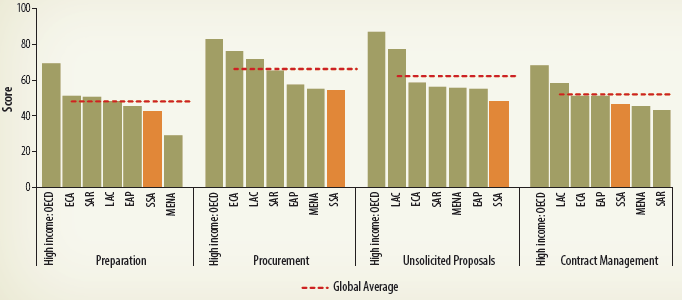
According to the BPPP, the region performs below average in each of the four thematic coverage areas: project preparation, procurement, unsolicited proposals, and contract management. Moreover, when compared with other regions, Sub-Saharan Africa places in the bottom two, except for contract management, where it places above the Middle East and North Africa and South Asia, but still below the global average. Sub-Saharan Africa's lowest performance is for the PPP preparation indicators (figure 2.50).
| FIGURE 2.50: Benchmarking PPP Procurement Scores, by Areas and Regional Average (score 1-100)
Source: Benchmarking PPP Procurement 2017. | The region performs below average in all the four indicators of the Benchmarking PPP Procurement report. The lowest performance is in PPP preparation |
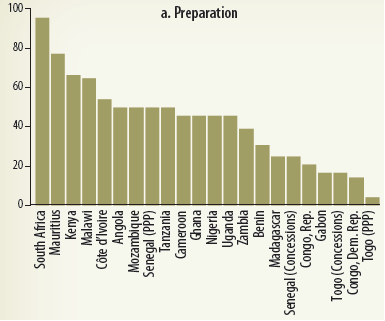
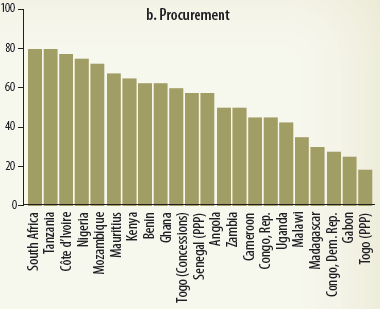
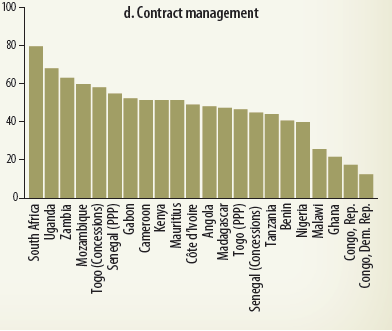
The average performance masks wide variation across countries. Procurement is the area where the economies obtained more similar and higher scores, indicating a more consistent and overall adequate performance (figure 2.51). However, even in this area there are outliers, such as the Democratic Republic of Congo, Gabon, and Togo (PPPs), which score significantly lower than the other economies in the region.
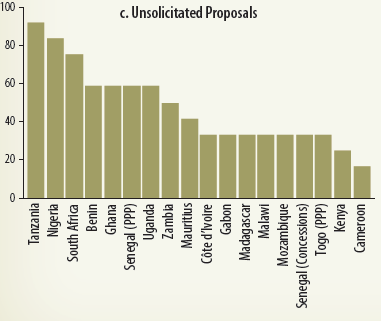
There are wide variations around unsolicited proposals, for which some countries have enacted comprehensive regulations (Tanzania, Nigeria, and South Africa), and others have regulations that are far from recognized good practice (Cameroon). Similarly, wide variations in scores appear around PPP project preparation, with some economies performing relatively well (South Africa and Mauritius), and others lagging (Togo and the Democratic Republic of Congo). South Africa has adopted comprehensive regulations on contract management, and scores very well in that area.
The area where there is more room for improvement is project preparation. The Benchmarking PPP Procurement 2017 data measure whether economies conduct six assessments: socioeconomic analysis, affordability assessment, risk identification, financial viability or bankability assessment, comparative assessment, and market assessment. Some economies conduct all these assessments (such as South Africa and Mauritius), while others conduct only one of them (Togo (PPP) and the Democratic Republic of Congo), or none at all (Togo (Concessions)). And in the Republic of Congo, Senegal (Concessions), Togo (PPP), and Zambia, the government is not required to integrate the prioritization of PPP projects with other public investment projects. The Benchmarking PPP Procurement report also examines whether the ministry of finance, or a central budgetary authority, needs to approve the PPP project before a procurement process is launched. The available information suggests that such an approval is not required in three of the 20 economies measured (Angola, Gabon, and Togo (PPP and Concessions)).
Overall, the regulatory frameworks governing the procurement of PPPs in the region have room for improvement in all areas, to increase the quality of the regulatory framework to match those in advanced economies. Preparation of PPPs appears to be the area where the region could focus its efforts to the improve regulatory frameworks for PPPs.
| FIGURE 2.51: Benchmarking PPP Procurement Scores for Sub-Saharan African Countries, by Thematic Area | |
|
|
|
|
|
|
| Source: Benchmarking PPP Procurement 2017. Note: The following economies do not have a regulatory framework that explicitly mentions unsolicited proposals (unsolicited proposals are not regulated, and therefore not scored: Angola, the Democratic Republic of Congo, the Republic of Congo, and Togo (Concessions). | |
___________________________________________________________________________________________
37 For more detailed information, visit http://bpp.worldbank.org/data/exploreindicators/PPP-procurement.
38 Angola, Benin, Cameroon, the Democratic Republic of Congo, the Republic of Congo, Côte d’lvoire, Gabon, Ghana, Kenya, Madagascar, Malawi, Mauritius, Mozambique, Nigeria, Senegal, South Africa, Tanzania, Togo, Uganda, and Zambia.