Public Procurement Practices
| Delivering infrastructure may require that governments acquire goods, services, or works from the private sector. This process of acquisition is called public procurement, and involves a wide array of economic sectors. | FIGURE 2.53: Public Procurement (% of GDP)
Source: Djankov, Saliola and Islam (2016). | South Asia has the highest share of public procurement in GDP, followed by Sub- Saharan Africa, reflecting in some cases the amount of development assistance that goes through public procurement. |
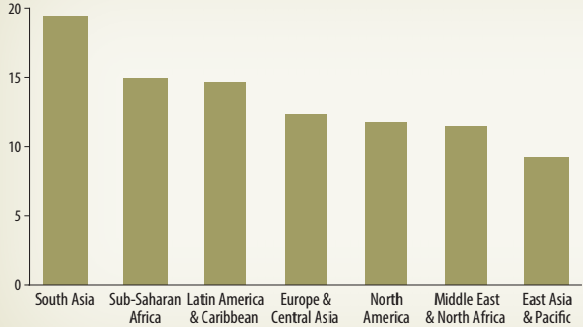
For instance, governments may rely on the private sector to supply goods and services to construct schools and hospitals, build a dam, or expand the road network Djankov, Saliola, and Islam 2016. Governments in developing countries are important players in the markets for goods and services. Figure 2.53 depicts the size of public procurement across world regions. South Asia has the highest share of public procurement in GDP (19.3 percent), followed by Sub-Saharan Africa (14.9 percent). For some countries in the region (for example, Eritrea and Angola), a considerable amount of development assistance goes through public procurement. Hence, the share of public procurement in Eritrea and Angola is 33 and 26 percent of GDP, respectively.
In addition to the institutions governing public management systems, the efficiency of investment also relies on sound procurement practices and sound institutions governing the public and PPP project cycles (see PPPs in Sub-Saharan Africa, in section 2.3). Broadly, the enhancement of public procurement practices (such as transparency, equal treatment, open competition, and sound procedural management) may boost competition in the markets for government goods and services, and render benefits for consumers in the form of greater quality and lower prices. Furthermore, transparent procurement processes will help reduce corruption (World Bank 2016a).
This subsection benchmarks aspects of public procurement. The procurement lifecycle of infrastructure projects covers the following dimensions: (a) needs assessment, call for tender, and bid preparation; (b) bid submission phase; (c) bid opening, evaluation, and awarding phase; (d) content and management of the procurement contract; (e) performance guarantee; and (f) payment of suppliers. The rationale and areas covered in these six stages of the procurement process are described in World Bank (2016a).
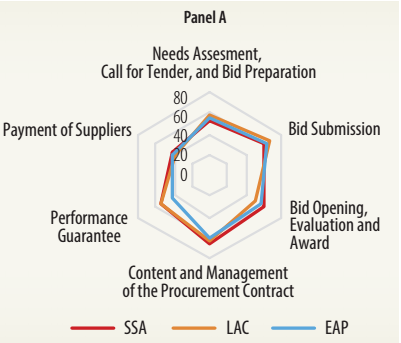
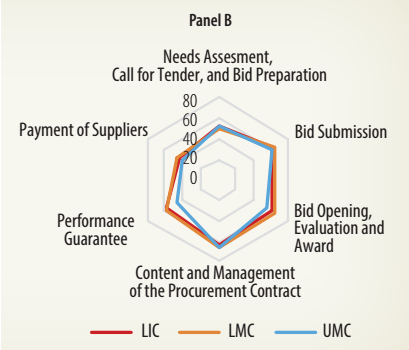
Figure 2.54, panel a, benchmarks the stages of the procurement lifecycle of infrastructure projects by the public sector in Sub-Saharan Africa vis-à-vis other developing regions, namely, East Asia and the Pacific and Latin America and the Caribbean. Sub-Saharan Africa is outperformed by the other two regions in the initial stages of the procurement cycle-that is, needs assessment, call for tender, and bid preparation, as well as bid submission. Sub-Saharan Africa's score on performance guarantee is comparable to that of Latin America and the Caribbean and outperforms that of East Asia and the Pacific. Looking at the income groups within Sub-Saharan Africa, LICs and LMCs have comparable scores in the stages of the procurement cycle, and tend to outperform UMCs in two areas: bid opening, evaluation, and award, and performance guarantee (figure 2.54, panel b).
| FIGURE 2.54: Benchmarking Public Procurement, and the Procurement Lifecycle | ||
| East Asia and Latin America do better at the initial stages of the procurement cycle than SubSaharan Africa. |
|
|
| Source: World Bank (2016b). Note: EAP = East Asia and the Pacific; LAC = Latin America and the Caribbean; SSA = Sub-Saharan Africa. | ||