3 What are PPPs?
The goal of PPPs is to exploit synergies in the joint innovative use of resources and in the application of management knowledge, with optimal attainment of the goals of all parties involved, where these goals could not be attained to the same extent without the other parties (see Jomo and Chowdhury 2009; Linder and Vaillancourt 2000). However, as the OECD (2012) highlighted: "there is no widely recognised definition of PPPs and related accounting framework. Eurostat, IASB, IMF, IFRS and others work with different definitions." Similarly, the IMF (2004) noted: "There is no clear agreement on what does and what does not constitute a PPP …The term PPP is sometimes used to describe a wider range of arrangements."
Annex 1 provides definitions of PPPs by selected international organizations and the private sector, including academics. Callan and Davies (2013, p. 6) observed, "it is a problem that the term "public-private partnership" is so bewilderingly catholic. Its meaning needs to be broken down in some way in order to permit sensible discussion".
As can be seen from Annex 1, not only different institutions promoting PPPs differ in their definition of PPPs, but also countries are using their own definitions in national laws and policies. Although there are some common elements, authors do not use the same language and include the same characteristics in defining PPPs. According to Romero (2015, p. 12), "The vast literature on PPPs reveals at least up to 25 different types of PPPs". Table 1 summarizes various conceptualizations of PPPs by different authors as well their implied dimensions.
The lack of definitional clarity may result from the fact that PPPs, according to Grimsey and Lewis (2005, p. 346), "…fill a space between traditionally procured government projects and full privatisation".5 In addition to PPP contracts, the space between traditional procurement and full-scale privatization may include short-term management and outsourcing contracts, concession contracts and joint ventures between the public and private sectors.
Table 1
Differing conceptualizations of public-private partnerships
| Definition | Dimensions |
| An arrangement between two or more entities that enables them to work cooperatively towards shared or compatible objectives and in which there is some degree of shared authority and responsibility, joint investment of resources, shared risk taking, and mutual benefit (HM Treasury 1998) | ◼ Inter-organizational relationship; ◼ Cooperation; ◼ Shared objectives; ◼ Joint investments; ◼ Risk sharing |
| Public-private partnerships are on-going agreements between government and private sector organizations in which the private organization participates in the decision-making and production of a public good or service that has traditionally been provided by the public sector and in which the private sector shares the risk of that production (Forrer et al. 2010). | ◼ Risk sharing ◼ Inter-organizational relationship |
| A legally-binding contract between government and business for the provision of assets and the delivery of services that allocates responsibilities and business risks among the various partners (Partnerships British Columbia, 2003) | ◼ Contractual governance; ◼ Risk allocation |
| The main characteristic of a PPP, compared with the traditional approach to the provision of infrastructure, is that it bundles investment and service provision in a single long term contract . For the duration of the contract, which can be as long as twenty or thirty years, the concessionaire will manage and control the assets, usually in exchange for user fees, which are its compensation for the investment and other costs. (Engel et al., 2008) | ◼ Bundling ◼ Service provision ◼ Long-term contract |
| Partnerships which include contractual arrangements, alliances, cooperative agreements, and collaborative activities used for policy development, program support and delivery of government programs and services (Osborne 2000) | ◼ Contractual governance; ◼ Inter-organizational relationship |
| A relationship that consists of shared and/or compatible objectives and an acknowledged distribution of specific roles and responsibilities among the participants which can be formal or informal, contractual or voluntary, between two or more parties. The implication is that there is a cooperative investment of resources and therefore joint risk-taking, sharing of authority, and benefits for all partners (Lewis 2002) | ◼ Inter-organizational relationship; ◼ Shared objectives; ◼ Mutual investments ◼ Risk sharing ◼ Benefit sharing |
| A relationship involving the sharing of power, work, support and/or information with others for the achievements of joint goals and/or mutual benefits (Kernaghan 1993) | ◼ Inter-organizational relationship; ◼ Cooperation; ◼ Power and information sharing ◼ Shared objectives |
Source: Roehrich et al (2014)
In practice, the definition of PPPs varies depending on the degree of ownership of assets and capital expenditure by the private partners. For example, in the case of management contracts, the private partners have very limited or no capital expenditure. On the other hand, in the case of a Design, Build, Own, Operate (BOOT) contract, the private partners are responsible for the design, building, operation and financing of a capital asset. In such a PPP, private partners receive payment from either the government (at regular intervals) or user charges, or both for delivering the services. Thus, there can be many variants of PPP schemes depending on the separation of asset ownership and risk-bearing between the public and private sector actors (Roehrich, et al. 2014). Figure 1 presents variations of PPPs in terms of distribution of responsibilities between the public and private sectors, asset ownership and the associated degree of public sector risk. It is important to note that the chart does not say anything about the relationship between different PPP contracts and their value for money (VfM), which will be discussed later. For example, while greater private sector responsibility will reduce public sector risk exposure by default, a badly designed PPP of any type can carry significant risks for the public in terms of reduced coverage, poor quality of service, or contingent fiscal liabilities. Figure 1 also proposes to distinguish between "core PPPs" and related arrangement. "Core attributes" for PPPs have the following characteristics (World Bank, 2012):
a. A long-term agreement between a government entity and a private company, under which the private company provides or contributes to the provision of a public service.
b. The private company receives a revenue stream- which may be from government budget allocations, from user charges, or a combination of the two-that is dependent on the availability and quality of the contracted service. The agreement therefore transfers risk from the government entity to the private company, including service availability or demand risk.
c. The private company must generally make an investment in the venture, even if it is limited, e.g., to working capital.
d. In addition to budget allocations, the government may make further contributions, such as: providing or enabling access to land; contributing existing assets; or providing debt or equity finance to cover capital expenditures. The government may also provide various forms of guarantee that enable risk to be shared effectively between the government and the private company.
e. At the end of the PPP contract the associated assets revert to government ownership.
Cross-industry studies also capture the variants in PPP arrangements including by sectors, project sizes and ownership structures. According to Roehrich et al (2014, p. 113), "Perhaps inevitably this diversity has meant that the specific definition and type of PPP project is often variable and sometimes unclear".
The wide range of contractual arrangements paired with the lack of clarity and variations in definition make it difficult to generalize findings about PPPs.
Figure 1
Variations of PPPs and distribution of risk
|
|
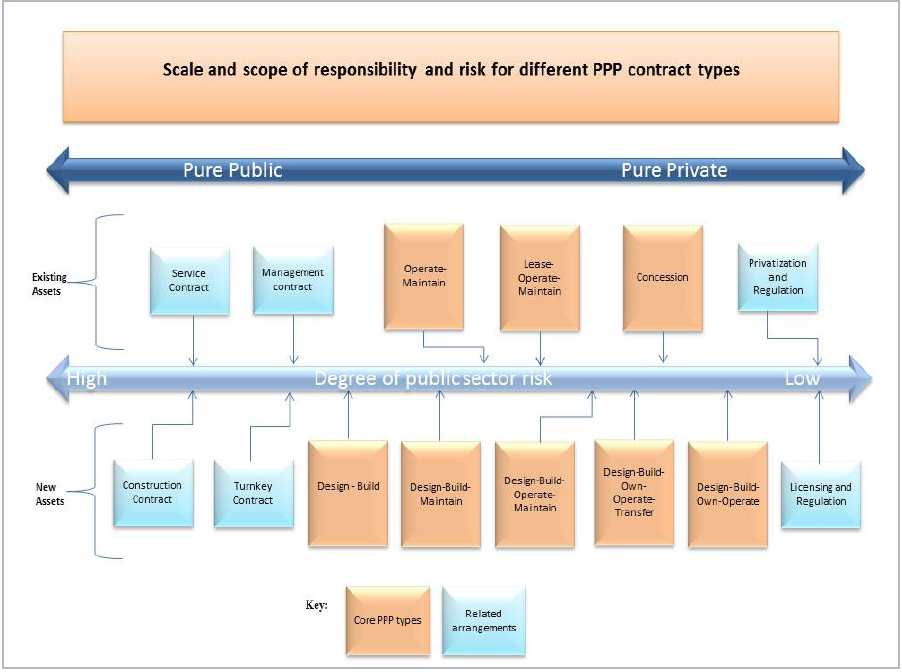
Sources: Based on World Bank (2012) and Roehrich et al (2014)
This is compounded by the paucity of studies or evaluation of PPPs in developing countries. "To date the predominant countries for PPP research have been the USA and UK (63% of the total PPP-related publications)" with some recent studies focusing on Australia, Netherlands and Germany (Roehrich et al. 2014, p. 113). The study of partnerships between official aid agencies and business or "blended finance" is even rarer as this is a very recent development (see Box 1).
___________________________________________________________________________________________
5 Quoted in OECD (2008, p. 16)