2.1 Spectrum of P3 Projects
Public-private Partnerships (P3s) are contractual agreements between public agencies and private entities that provide greater private participation in the delivery and financing of transportation projects compared to the traditional design-bid-build public procurement model. Under the traditional approach, project sponsors execute separate contracts for the design of projects and then for their construction, and then they operate and maintain the infrastructure following construction.
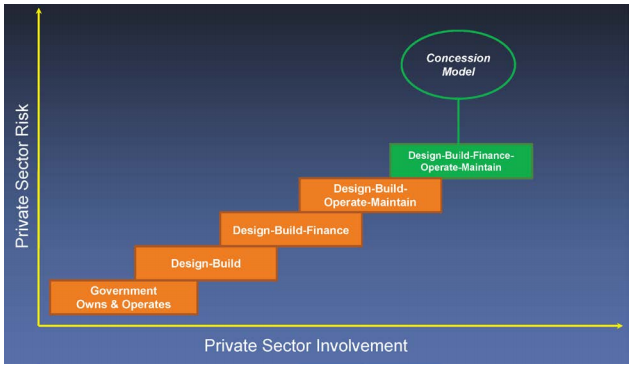
There are many different forms of P3s. Transportation P3 arrangements range from design-build procurements, where design and construction services are grouped into a single, fixed-price contract, to concessions, where a private investor/operator is responsible for financing, designing, constructing, operating, and maintaining new highway projects in exchange for the right to collect the revenues generated by the project or availability payments from the public sponsor for the duration of the concession period. As shown in Figure 2-1, the primary distinction between them is the specific responsibilities and level of risk that is assumed by the private partner.
The following discussions provide brief overviews of the four P3 typologies shown in Figure 2-1. However, the focus of FHWA's Report on P3s is on design-build-finance-operate-maintain (DBFOM) P3 arrangements, which are also known as "concessions."
Figure 2-1: Spectrum of P3 Procurement Options and Risk Exposure