Project Financing and Implementation
| The financing package for the Capital Beltway HOT Lanes included $348.7 million in at-risk shareholder equity provided by Capital Beltway Express. In addition, the company secured a $588.9 million loan from the U.S. Department of Transportation's (USDOT) Transportation Infrastructure Finance and Innovation Act (TIFIA) credit program. This program lends money to projects of national significance at low interest levels available only to the U.S. government. In addition, the company received approval from USDOT to raise $589.0 million by selling tax-exempt Private Activity Bonds (PABs). The Commonwealth of Virginia issued the PABs on behalf of Capital Beltway Express. The TIFIA loan and PABs reduced the concession company's financing costs and will be repaid with project revenues during the 75-year concession period. VDOT also contributed $495 million in public funding. This was an increase above the $409 million it agreed to contribute in 2007, due to scope addtions. VDOT's contribution is a subsidy and will not be repaid. | I-495 Capital Betway HOT Lanes
|
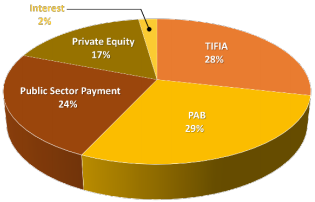
The project marked a number of precedent-setting "firsts" in transportation project delivery in the US. It was the first to use dynamically priced tolls to leverage a project financing package. It was also the first transportation project to use PABs in the United States.
The concession agreement shifts certain risks from VDOT (and the taxpayer) to the private developer. For example, Capital Beltway Express has unrestricted rights to set tolls, but at the same time has assumed the risk of lower-than-projected toll revenues. Revenues generated from the tolls are intended to cover all project costs, including debt service, operations, maintenance and administrative costs, as well as provide a reasonable return on investment.
Many contractual provisions exist to protect the public interest. For example, if the HOT lanes exceed financial expectations, excess toll revenues will be shared with VDOT. Additionally, the concession contract includes condition, performance and safety standards. Capital Beltway Express must hand the facility back to VDOT in a state of good repair at the end of the concession period. VDOT retains ownership of the land and improvements, as well as oversight of the HOT lanes.
Construction began in spring 2008 and the facility opened to traffic ahead of schedule in November 2012.
Due to a lower than expected toll revenues during the first two years of operations, Capital Beltway Express and its lenders restructured the project's debt. They used an additional $280 million in private equity from Capital Beltway Express and $150 million in existing project reserves to reduce the PAB debt-which must be repaid before the TIFIA loan-by 60 percent. This change improves Capital Beltway Express' credit structure and strengthens the creditworthiness of the TIFIA loan by reducing the project's overall debt load. The agreement was finalized in May 2014.