Project Overview
The $2.65 billion, 13-mile LBJ Express project in the Dallas-Fort Worth Metroplex rebuilt and expanded the northern portion of the I-635 (LBJ Freeway) loop around Dallas. The LBJ Freeway is one of the busiest highways in Texas and is congested virtually round-the-clock. Traffic counts are projected to continue climbing as some of the fastest population growth and development in the nation is occurring along this corridor. |
|
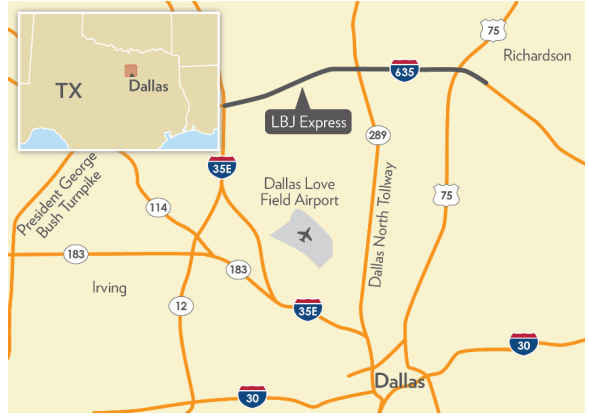
The project included construction of four to six new lanes (two to three in each direction) between I-35E and U.S. 75. These new lanes are located partially underneath the current LBJ Freeway and are operated as tolled managed lanes. The existing non-tolled lanes were reconstructed and cantilevered above the managed lanes. This innovative design allows the capacity of the facility to be almost doubled while maintaining the same footprint as the original LBJ Freeway. The project also included the construction of two elevated tolled managed lanes in each direction along I-35E from its interchange with the LBJ Freeway south to Loop 12.
The new managed lanes, now known as the LBJ TEXpress Lanes, allow drivers without passengers in their vehicles to pay a toll when they want to avoid travel delays on the (free) general-purpose lanes. Prices on the managed lanes are dynamically set-as often as every five minutes-to keep traffic moving at speeds of at least 50 miles per hour. The LBJ Express uses an electronic open-road tolling system that allows traffic to enter and exit the managed lanes without passing through tollbooths. High-occupancy vehicles with two or more passengers may register to receive a 50 percent discount on the toll during the rush hour. All vehicles pay full toll rates at other times regardless of the number of passengers they are carrying.