Project Financing and Implementation
| The I-95 HOV/HOT Lanes project's financing for capital construction includes a mix of debt, public funds, and private equity. 95 Express' sources of financing include $253 million in tax-exempt bonds (including the bond sale premium) that the public sector issued on behalf of the concession company. These Private Activity Bonds, or PABs, allowed 95 Express to gain access to the tax-free municipal bond market, lowering its interest rates substantially. 95 Express also received a $300 million loan from the Federal credit program known as TIFIA (the Transportation Infrastructure Finance and Innovation Act). The TIFIA program provided the project with a low-interest loan that will be subordinate to the PAB debt (except in the case of default). In addition, 95 Express has contributed $280 million in equity to the project. Interest earnings amount to another $7 million in project funding. |
|
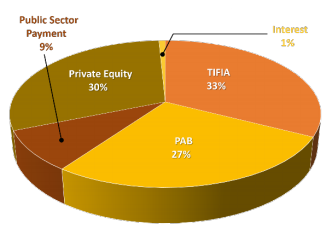
The project's debt will be repaid from future toll proceeds collected over the 76-year period 95 Express was granted to construct and operate the project. 95 Express reached financial close on the PAB debt in July 2012. Financial close on the TIFIA loan and remaining funding occurred in November 2012.
In addition, VDOT contributed $83 million in public funding toward the costs of the project using GARVEE funding. GARVEEs are "grant anticipation revenue vehicles," which allow states to fund a project in advance of receiving anticipated Federal-aid funding to repay the debt.
Outside of the $923 million project capital cost, VDOT also incurred $46 million in costs for preliminary engineering prior to executing the agreement with 95 Express and expected to spend $73 million on project management and oversight during construction.