Project Financing and Implementation
| The total cost of Phase 1 was $312 million. The project drew on a variety of direct public funding sources, including $112 million from dedicated regional transit sales taxes; $46.6 million in regional federal funds provided by the Denver Region Council of Governments, a $4.8 million TIGER grant; $41.4 million in CDOT funds; and $5.5 million from local governments. The Colorado Bridge Enterprise also dedicated $41.5 million from a previous sale of Build America Bonds (BABs) to the project. Established under the American Recovery and Reinvestment Act of 2009, the BAB program made special tax credits and federal subsidies available to issuers of taxable municipal bonds. The Colorado Bridge Enterprise BABs were backed by a special bridge safety surcharge on vehicle registrations in Colorado. Additional project financing was obtained through a $54 million TIFIA loan leveraging future toll revenues generated on the managed lanes. | U.S. 36 Express Lanes (Phase 2)
|
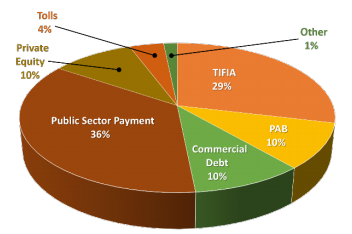
The total cost of Phase 2 was $208 million. Public funds provided $75.2 million of this cost, including $25.6 million in direct expenditures by CDOT/HPTE and $49.6 million in payments to Plenary during construction. Revenue sources for these public funds included $15 million in Federal funds; $18.9 million in state funds; $30.5 million from dedicated regional transit sales taxes; and $10.8 million in local government funds.
Plenary's financing sources for its portion of the Phase 2 project costs included $20.6 million in tax exempt bonds that the public sector issued on behalf of the concession company. The Private Activity Bonds, or PABs, allowed Plenary to gain access to the tax free municipal bond market and lower interest rates. Plenary's financing also included a $60 million TIFIA loan; a $20.6 million commercial loan; $20.6 million in equity from the partners in the concession; and $12 million in toll and other revenues generated by the I-25 Express Lanes and the Phase 1 managed lanes while Phase 2 was under construction.
The TIFIA loan for Phase 2 is secured by a pledge of revenues from the I-25 Express Lanes (existing) and the U.S. 36 Phase 1 (upon the transfer to Plenary) and Phase 2 managed lanes. Plenary also assumed the TIFIA Phase 1 loan at substantial construction completion when HPTE transferred responsibility for operating that segment to Plenary. Plenary will operate and maintain the U.S. 36 Express Lanes (Phases 1 and 2) and the existing seven-mile portion of the I-25 Express Lanes south of U.S. 36 until 2065.
Plenary will repay its debt over a 50-year period using toll proceeds from the new lanes on U.S. 36 and the existing lanes on I-25. If toll revenue surpasses an agreed rate of return, toll revenue will be shared with HPTE. Plenary has also agreed to maintain minimum travel speeds for buses using the lanes. Toll rates will be based on a fixed schedule that varies by time of day. Plenary also has the option to migrate to a dynamically priced toll regimen where toll rates would vary in real time based on actual congestion conditions in the I-25 and U.S. 36 corridors. On January 1, 2017, the HOV policy granting free use of the managed lanes will shift from requiring two or more people to three or more people.