Project Financing and Implementation
| I-77 Mobility Partners secured its financing for the $636 million I-77 Express Lanes on June 26, 2014-a milestone known as reaching financial close. It is financing the project using a combination of debt, funding provided by NCDOT, and its own equity. The debt package includes $100 million in Private Activity Bonds (PABs) (plus $3.6 million in bond sale premiums) issued by the State of North Carolina on behalf of I-77 Mobility Partners. PABs enable private developers of transportation projects to access the municipal debt market and thereby lower their financing costs. In order to use PABs on a given project, the US Department of Transportation must first award a PAB allocation. I-77 Mobility Partners will repay the PABs with future toll proceeds. | I-77 Express Lanes
|
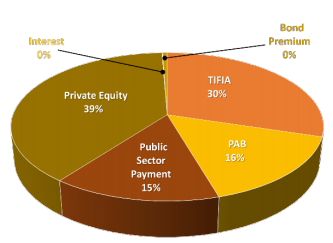
I-77 Mobility Partners is also the recipient of a $189 million loan from the TIFIA federal credit program. The TIFIA program offers flexible repayment terms and provides the concession company with relatively low interest rates. The loan has a maximum term of 35 years and repayments can begin up to five years after the project's substantial completion. In the event that I-77 Mobility Partners files for bankruptcy, the TIFIA loan will be repaid at the same time as the PABs.
The State of North Carolina has provided $94.9 million in funding for the project. In addition, I-77 Mobility Partners is investing $248 million of its own equity in the project. Cintra has contributed approximately $225 million of this amount, while Aberdeen Global Infrastructure Partners II contributed the remaining $23 million.
In April 2015, Fitch ratings assigned an investment-grade rating of BBB- to the PABs and TIFIA loan issued for the project. Fitch's rating reflected the project's strategic location in a metropolitan region that is experiencing continuing growth and has long-standing congestion issues. The project lacks any current or planned competing routes that could cause traffic diversion, increasing the likelihood of steady demand for the Express Lanes. Additionally, I-77 Mobility Partners maintains the right to set tolls at a dynamic rate. The toll rates will rise and fall with the demand in the Express Lanes. If there are more cars using the Express Lanes, the toll rate will rise to discourage more vehicles from entering the lanes and increasing congestion. Toll rates will drop to encourage drivers to use the lanes when there is little traffic in the lanes.
NCDOT has provided a contractual provision known as a developer ratio adjustment mechanism (DRAM) that has enhanced the creditworthiness of the project. Under the DRAM, if the projected debt payment exceeds the amount of cash that I-77 Mobility Partners has on hand, NCDOT will cover the difference. NCDOT's payment assistance will not exceed $12 million in a year or $75 million over the concession term. In the event that the concession company defaults on its debt payments, the state can take over the contract for 50 to 60 cents on the dollar and will be entitled to all future toll revenues.
The I-77 Express Lanes has generated controversy. Local grass roots groups, including "Widen I-77" have campaigned heavily against the project, arguing that the state should add free lanes to the corridor. The group sought a court injunction against the project, alleging that NCDOT's contract with I-77 Mobility Partners is unconstitutional. Additionally, Widen I-77 alleged that the North Carolina General Assembly unconstitutionally delegated authority to NCDOT to toll the Express Lanes. NCDOT warned opposition groups that cancelling the contract with I-77 Mobility Partners could cost the state as much as $300 million.
In December 2015, John Laing Group, a British infrastructure developer, became an equity investor in the project. John Laing invested $25 million in the project, reducing Cintra's contribution to $200 million or roughly 80 percent of the total project equity investment. John Laing was interested in the project for its potential to provide stable long-term returns for its investors, as the Charlotte region and the I-77 corridor are predicted to grow for decades to come.
In January 2016, a judge ruled against Widen I-77, stating that the agreement between I-77 Mobility Partners and NCDOT was legal and that NCDOT has the right to toll the Express Lanes. Widen I-77 continued to oppose the project, seeking to stop the project through political means. The strategy was unsuccessful, as the Charlotte City Council and the Charlotte Regional Transportation Planning Organization have since both voted in favor of advancing the project.