Project Financing and Implementation
| GLC was not able to secure financing for Phase II of the Presidio Parkway until June 2012. The delay was due to a legal challenge from the state's union representing Caltrans' engineers. The union had originally challenged the P3 deal in late 2010, but an appellate court ruling in December of that year permitted the agreement to move ahead. However, a further appeal to the state Supreme Court was not resolved until late 2011 when the court declined to review the case. In the interim, Caltrans made bridge loans to GLC to allow Phase II design work to proceed. The union had objected to funding the availability payments with future state transportation funds. They viewed this approach as opening the door to a larger number of private firms-essentially competitors to the state's public engineers-who would be willing to pursue availability payment P3s in the state, compared to the smaller number of firms that would be willing to enter into P3 agreements supported instead by toll revenue and assume the associated traffic risk. | Presidio Parkway
|
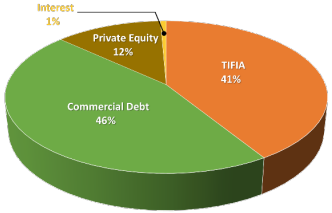
GLC's Phase II $365 million financing package includes $46 million in equity from the concession partners, $166 million in short-term commercial bank debt issued by a group of five banks, $2.5 million in interest, and $150 million in loans from the U.S. Department of Transportation's TIFIA program. TIFIA-the Transportation Infrastructure Finance and Innovation Act-provides low cost, flexible credit assistance to transportation projects of national and regional significance.
The flexibility offered by TIFIA was key to the Presidio Parkway's successful financing. TIFIA's credit support was provided to the concessionaire in two loans. One is a short-term, $90 million loan that the company will repay upon final delivery of the project. The second is a $60 million, long-term loan that will be repaid over the life of the concession via the non-Federal portion of the availability payments. This precedent-setting financing structure reduced interest costs and aligned repayments with available non-federal funding sources.
Another essential component to the project's viability was a new FHWA policy allowing state DOTs to apply their Federal-aid funds to availability payments. FHWA determined that the P3 agreement defines the project in a way that allows it to be treated, for purposes of determining Federal-aid eligibility, in a manner similar to that of a traditional public works project.
Under the P3 agreement, GLC will also receive "milestone payments" upon substantial completion of the project funded with state and local transportation funds from a number of regional entities. These agencies include the San Francisco County Transportation Authority, which manages administration of a local transportation sales tax; the Golden Gate Bridge, Highway and Transportation District, which operates the bridge; the region's metropolitan planning organization-Metropolitan Transportation Commission; and two other regional planning and local tax-administering agencies-the Transportation Authority of Marin County and the Sonoma County Transportation Authority. GLC will use these payments to pay off its commercial bank debt as well as the short-term TIFIA loan. GLC will utilize its availability payments of $22.1 million, received annually over the life of the concession, to cover routine operations and maintenance costs, capital repairs, and TIFIA loan payments, and to provide the company with a return on its equity investment.
Phase II construction began in late 2012, and major construction was complete in July 2015 when traffic was shifted from the Phase I construction bypass to the permanent route. Landscaping and final restoration took place throughout 2016. At the end of the concession in 2045, ongoing operations and maintenance responsibilities will revert to Caltrans.