Project Financing and Implementation
| The total cost of delivering the project borne by Portsmouth Gateway Group is $556.8 million. This includes the cost of design and construction, as well as financing and other project development costs. Additional preconstruction costs, including environmental analysis, preliminary engineering, and right-of-way acquisition paid for by ODOT total approximately $89.5 million. Portsmouth Gateway Group has financed the project by combining a $209.3 million TIFIA loan and $251.2 million in private activity bonds (including the sale premium above the bonds' face value). Private activity bonds allow a private entity to gain access to the tax-free municipal debt market and require federal approval for their use. ODOT had obtained this approval in November 2013, anticipating that they might be a necessary component of a private partner's financing package. The TIFIA loan was especially critical to the project's financial viability, as it carried a 1.27 percent interest rate. This rate was 50 percent less than rates for other TIFIA loans at the time because the project qualified for a special rural designation created by Congress in federal transportation legislation enacted in 2012. Portsmouth Gateway Group has also invested $48.9 million of its own capital in the project and will apply about $4 million in earned interest. | Southern Ohio Veterans Memorial Highway
|
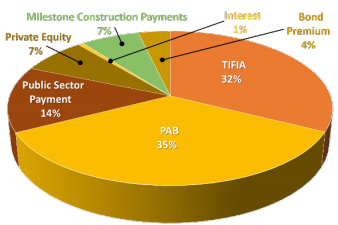
At the time the procurement started, ODOT had reserved approximately $120 million in federal funds-anticipating it would build the project traditionally in phases-including $97 million in Appalachian Development Highway System funds dedicated to roads on that network. Once the P3 approach was selected, ODOT used these funds to cover its own costs for right-of-way acquisition and three milestone payments during construction. ODOT will make the milestone payments totaling $44 million when the project is 70 percent, 80 percent, and substantially complete. These payments will repay a portion of the private partner's upfront capital costs.
Availability payments begin after substantial completion and are made monthly with potential deductions if the developer does not meet certain performance expectations. FHWA policy permits state DOTs to apply their Federal-aid funds to availability payments. ODOT will use traditional funding from federal and state taxes on motor vehicle fuels to cover the cost of the availability payments. The private partner will use the availability payments to repay its debt and cover operations and maintenance costs. ODOT will retain some operations responsibilities including snow removal, incident response and maintenance of equipment that provides information on weather conditions on the facility.
ODOT's P3 policy prioritizes the availability payments ahead of other ODOT financial obligations. This policy lends assurance to the private partner that its compensation will not be impacted by state financial or political changes over time. The policy also ensures that the funds (debt service) required to pay the capital portion of the availability payments do not exceed 20 percent of state and federal funds available to ODOT for highways.
Construction on the project began in June 2015 and is expected to be substantially complete by the end of 2018, at which point the 35-year operations and maintenance period will start.