2.26.10 Concurrent Delays (clause 26.14 and 35.8)
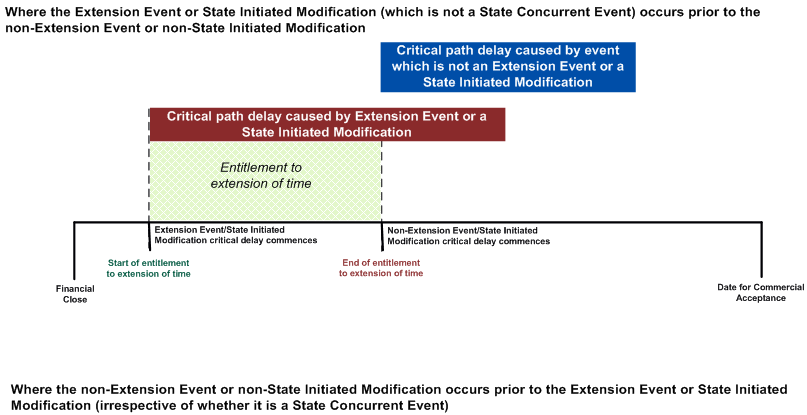
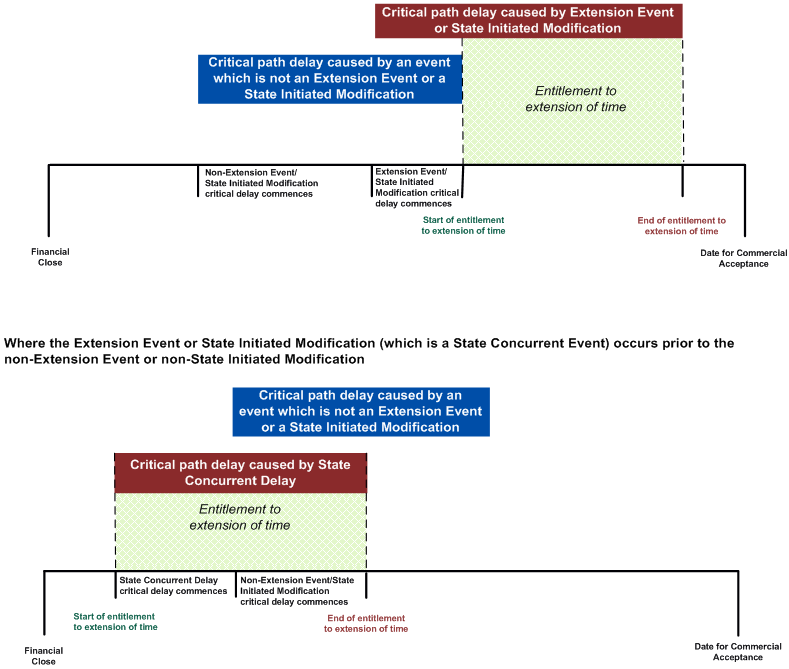
The concurrent delay principle limits Project Co's entitlement to time and cost relief for an Extension Event or a State Initiated Modification where, at the same time as the delay caused by the Extension Event or the State Initiated Modification, Project Co is also being delayed by an event which is not an Extension Event or a State Initiated Modification (refer to section 2.43.2.4 for further details). This limitation applies whether or not the Extension Event or State Initiated Modification occurs first in time.
The exception to this principle is where there is a State Concurrent Event which occurs before the other concurrent event which is not an Extension Event or State Initiated Modification. State Concurrent Events consist of:
• an Extension Event which is a State breach of a State Project Document or an act or omission of the State or an Associate of the State when acting in connection with the Project which is not a Permitted Act; and
• State Initiated Modifications.
In those circumstances, Project Co will be entitled to be paid Development Phase Finance Interest but not Prolongation Costs for the extension of time for the State Concurrent Event, effectively ensuring Financiers are kept whole and therefore relieving the D&C Contractor from paying liquidated damages.
This approach to risk sharing for Concurrent Delay reflects a fair and common sense approach to causation.
Diagram 13 below illustrates where Project Co's entitlement to claim an extension of time is limited by the concurrent delay principle set out in clauses 26.14.
Diagram 13