Who is the private party?
The private party is the party that enters into the project deed with the government.
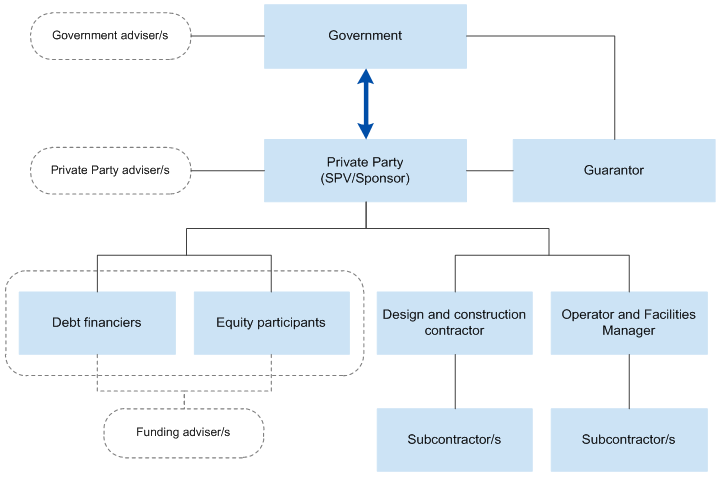
Typically, the private party will comprise a consortium of debt financiers, equity investors, a builder, a facility management subcontractor and potentially an operator (in projects where the operations have been outsourced to the private sector). Figure 2.2 shows a typical consortium and its relationship with the government party. In most projects, the consortium forms a special purpose vehicle specifically for the purposes of the PPP project. This special purpose vehicle enters into the project deed with the government party and is referred to as the private party.
The contract director's primary point of contact for the project will be the nominated representative of the private party. In some cases, the private party will engage a specialist asset manager under an asset management agreement. The role of the asset manager is to provide whole-of-life asset management services on behalf of the consortium members, and they will be a primary contact for the contract director. The contract director may also on occasion interact with a representative of the facility management subcontractor during the service delivery phase.
Figure 2.2: Typical private sector consortium
Occasionally, the private party is a company that already has other significant business activities, or has subsequently undertaken other business activities. Where the private party is not a special purpose vehicle, there are both risks and benefits for government.
Risks include:
• the private party, and hence the project, may be affected by its other interests - poor performance of its other activities may even result in the private party becoming insolvent; or
• there may be a loss of transparency, as management of the project by the private party (and the consequent costs) may be intermingled with management (and costs) of its other business activities - this can add complexity to the operation of various contractual mechanisms such as the sharing of additional revenues and refinancing gains, and the pricing of modifications.
Benefits include:
• the private party's other business interests mean that it is not dependent upon the individual project, and therefore may have greater ability to effectively manage challenging project circumstances; or
• there may be efficiencies for the private party in operating a number of similar businesses, which may result in financial benefits for government. For example, the private party may be able to refinance on better terms than if it was a special purpose vehicle, and government may share in this benefit.
If the private party requests the government party's approval to undertake activities other than the project activities under the project deed, the contract director should seek advice on the potential implications and take action to ensure that the government party is, on balance, no worse off.