7.1 Why manage knowledge and information?
Effectively managing knowledge and information is essential to:
• ensure the continuity and availability of project knowledge and information assets throughout the project lifecycle; and
• meet legislative, policy and contractual requirements.
In order to meet a government party's governance and compliance obligations (see Chapter 3), it is essential to have effective knowledge and information management processes. This chapter is about developing an integrated project knowledge and information management strategy.
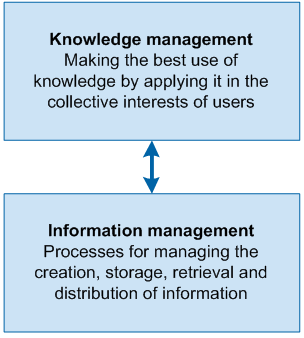
| • Information is data in context that can be used for decision making. • Knowledge is a body of facts, information or skills acquired through experience or education. It provides theoretical or practical understanding of a subject. • Information management is the means and processes by which an organisation manages the creation, collection, storage, retrieval and distribution of information resources. It is technically part of a larger continuum of managing knowledge in an organisation or project. • Knowledge management is a multidiscipline approach to achieving organisational objectives by making the best use of knowledge. • Records management is a component of information management and is concerned with corporate records that document and verify business activities.4 |
Figure 7.1: The relationship between knowledge management and information management
Initially, the contract management team should identify the government party's knowledge assets and, where possible, use an electronic recordkeeping system to monitor and record key project performance and activities. It is most useful when the information management system records 'tacit' knowledge5 in addition to explicit knowledge and key project decisions.
Knowledge management is an important part of succession planning to ensure a seamless transition when contract management personnel change.
______________________________________________________________________________________________
4 Definitions adopted or adapted from those contained in Standards Australia International Ltd, Australian Standard AS 5037 2005, Sydney.
5 Tacit knowledge is that which resides in a person's mind, and may include aspects of culture or 'ways of doing things': Standards Australia, Interim Australian Standard AS 5037 (int)-2003, op. cit.