Channels of PPP Impacts
As well as project contexts, certain macro variables are vital for successfully carrying out infrastructure PPP projects. Much of the recent literature on the determinants of PPP activities revolve around the role of institutions. Yehoue, Hammami, and Ruhashyankiko (2006) find that less corruption and effective rule of law are associated with more PPP projects. Schomaker (2014) finds that a high degree of institutional quality is associated with stronger private sector participation in providing public services. Another important channel is how infrastructure PPPs free up resources for public services in human capital development and social security.
Figure 2.4 shows the different channels through which PPPs, either as an infrastructure project or a public finance tool, can affect macroeconomic performance. PPP contracts that emphasize the quality of infrastructure, particularly delivering a project on time and maintaining it well, strengthen the infrastructure-growth link. The higher-level skills needed for complex PPP contracting could help strengthen institutions, which is deemed crucial for Asia's economic development. And the technical and institutional capacities, and good governance required for PPPs can be deployed in other public services.
Figure 2.4: PPP-Economic Growth-Poverty Nexus
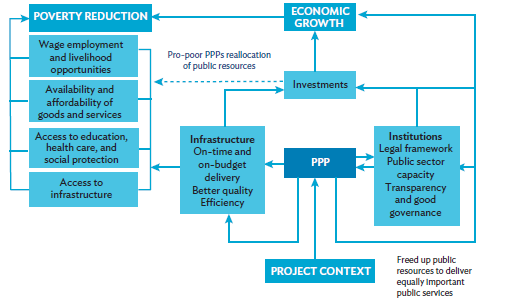
PPP = public-private partnership.
Source: Authors.
PPPs can co-opt the private sector into national development plans through bankable infrastructure projects, since these partnerships have a huge-but so far largely untapped-potential to attract long-term savings in the form of pension, insurance, and sovereign wealth funds for infrastructure projects offering higher returns for the risk. Matching long-term savings to PPP project will help optimize resource allocation, and contribute to economic growth (Arezki et al. 2016).
The underlying rationale for PPPs to build better-quality infrastructure is a necessary condition for spurring economic growth, and for eventually reaching the poor by expanding wage employment and livelihood opportunities. Low-income households should have access to infrastructure services, and be able to afford them as they generally spend more on basic goods and services. Wallich (2002) notes that, without both, the poor are often at the mercy of more expensive alternatives for safe water and electricity. The Pro-Poor Public-Private Partnership, a UNESCAP initiative, sets up community-based utilities using public and private investments. Among those that have been set up are renewable energy projects in underserved rural communities in Indonesia, the Lao People's Democratic Republic, and Nepal that provide affordable electricity, as well as incomes and livelihoods (UNESCAP 2014).