PPP Readiness
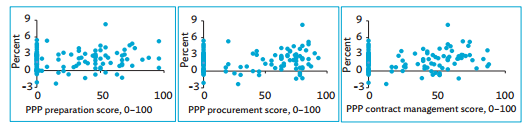
Instead of using popular measures of PPPs, such as amount of investment and number of projects, we examine how economic growth relates with capabilities to handle the complexity of these projects for preparation, procurement, and contract management. These measures capture the institutional and capacity improvements that could be attributed to PPP practices. Figure 2.6 shows the positive relationship between economic growth and government capabilities to handle PPPs in different areas.
Figure 2.6: Average Real Per Capita Gross Domestic Product Growth and Capabilities to Manage PPPs
PPP = public-private partnership.
Source: World Bank. 2016. Benchmarking Public-Private Partnerships Procurement. Washington, DC.
Implementing PPP projects is an opportunity to reexamine regulatory and policy framework to improve governance and public sector capacity. For example, Taipei,China, learning from its first experience with a large PPP project for a high-speed rail system, passed legislation in 2000 to promote private participation in infrastructure projects, which became the institutional framework for PPPs there.
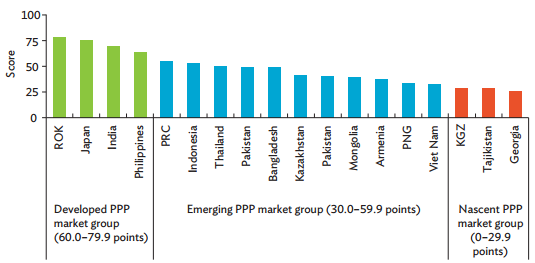
Developing economies in Asia and the Pacific have significantly improved their capacity to handle PPP projects (Figure 2.7). Their regulatory and institutional frameworks, investment climate, and financial facilities are increasingly being geared toward promoting PPPs-and this may have led to the growing use of PPPs for infrastructure in some countries.
Figure 2.7: PPP Readiness Scores in Asia and the Pacific, 2014
KGZ = Kyrgyz Republic, PNG = Papua New Guinea, PPP = public-private partnership, PRC = People's Republic of China, ROK = Republic of Korea.
Source: Economist Intelligence Unit. 2014. The 2014 Infrascope Index and Report. London.