Operation and Management: Settling PPP Disputes
Because of the complexity of PPP projects and the way risk is allocated, disputes among stakeholders are frequent. KDI (2014), in a survey, found 69% of PPP stakeholders in the Republic of Korea experienced disputes and that these took a long time to resolve. Table 8.13 shows dispute resolution periods for PPPs in three infrastructure sectors in 2014.
Table 8.13: Average Dispute Resolution Periods for PPPs in the Republic of Korea, 2014
Sector | Under 3 Months | 3-6 Months | 6-2 Months | 1-2 Years | 2 Years | Total |
Environment | 25.0 | 25.0 | 0.0 | 50.0 | 0.0 | 100.0 |
Road | 50.0 | 0.0 | 50.0 | 0.0 | 0.0 | 100.0 |
Harbor | 0.0 | 0.0 | 33.3 | 0.0 | 66.7 | 100.0 |
Total | 22.2 | 11.1 | 22.2 | 22.2 | 22.2 | 100.0 |
PPP = public-private partnership.
Source: Korea Development Institute. 2015. Collection of Education Material for Public-Private Partnerships. Vol. 6. Sejong.
There are essentially four ways of resolving a PPP dispute-negotiation, mediation, arbitration, and court adjudication-and each has its own characteristics (Table 8.14).
Table 8.14: Dispute Resolution Processes
Feature | Negotiation | Mediation | Arbitration | Court Adjudication |
Voluntary/ involuntary | Voluntary | Voluntary | Voluntary | Compulsory |
Third party engagement | No | Mediator | Agent | Judge |
Degree of formality | No restriction | No restriction | By processes and standards determined by consent among involved parties | Under legal enforcement |
Nature of proceeding | Unlimited submission of evidence | Unlimited submission of evidence | Prove claim from each party | Prove claim from each party |
Outcome | Consensus | Consensus | Award | Court ruling |
Binding | Settlement by contract | Settlement by contract | Executive force | Executive force |
Private/public process | Private | Private | Private (and public if needed) | Public |
Source: Korea Development Institute. 2015. Collection of Education Material for Public-Private Partnerships. Vol. 6. Sejong.
Negotiation. This is the most common form of dispute resolution of the four methods. It has the benefit of costing less than the others, it can prevent sensitive information from getting out, and amicable relationships between PPP partners have a better chance of being maintained than in the other methods.
Mediation. Mediators use diverse techniques to help disputing parties find an optimal solution in a dispute, but they have no decision-making authority. For mediation to work, mediators must be seen by both parties as fair and neutral.
Arbitration. This is a method for resolving a dispute without going to court. Opposing parties refer their dispute for arbitration and agree to be bound by the arbitration decision, which is binding on the parties. An arbitration ruling impedes the right of access to court adjudication.
Court adjudication. This tends to incur considerable costs and time before a ruling is made, and-an additional drawback-a ruling can be made regardless of field of expertise.
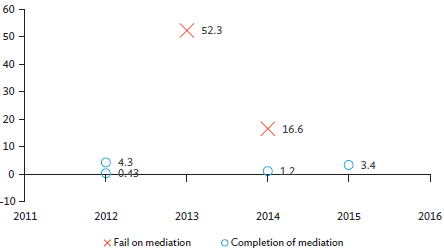
PPP disputes have multiple causes, including how laws and regulations affecting partnerships are interpreted, financing arrangements, and which technologies are used in a project. Figure 8.3 shows that voluntary dispute resolution methods rather than going to court are preferred in the Republic of Korea when the amounts involved are relatively small.
Figure 8.3: Performance of PPP Dispute Mediation in the Republic of Korea
PPP = public-private partnership.
Source: Public and Private Infrastructure Investment Management Center, Republic of Korea.
The Republic of Korea's experience in resolving PPP disputes offers useful pointers for countries working to improve their dispute resolution methods. Because settlements in negotiation, mediation, and arbitration processes are not binding, PPP disputes tend not to be resolved through those channels in the Republic of Korea. Because a dispute between public and private sectors is basically a zero-sum game, it is seldom possible to satisfy both parties through these resolution methods. For negotiation and mediation, a consensus on how to solve a dispute is needed among the parties, but getting one is often difficult. For arbitration, an unsatisfied party can ignore the decision and opt to go to court to resolve the dispute. As a result, many PPP disputes in the Republic of Korea end up in court, although smaller disputes, as earlier noted, often get settled out of court using one of the other three methods. Since 2012, the Dispute Mediation Committee, which is under the Ministry of Economy and Finance, has heard seven PPP cases, with four of them each involving less than W4.37 billion ($4 million) and being resolved outside court.