Basic Structure of a PPP in the Republic of Korea
A special purpose vehicle (SPV), a legal entity that acts as the concessionaire, needs to be established to implement a PPP project in the Republic of Korea. SPVs are generally made up of construction companies, financial investors, and professional operators who recover their investment from profits on construction, dividends, or interest payments. After being set up, an SPV needs authorization from the competent authority-the procurement agency-to initiate a design-build-finance-operate process.
In a traditional procurement, the competent authority selects a private firm to design and build a project. After financing the project, the government can either manage and operate the facility itself or select an operator to do this. In a PPP project, the whole implementation process is granted to a single entity. Figure 9.1 shows a typical PPP structure in the Republic of Korea. The competent authority can be a public sector entity, such as a local government or line ministry responsible for implementing a PPP project. It should consider, among other things, the feasibility of proposed projects and their consistency with long-term policy directions.
Figure 9.1: Basic Structure of a PPP in the Republic of Korea
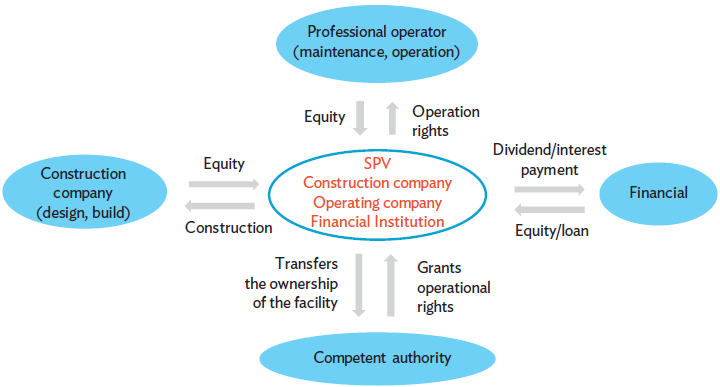
SPV = special purpose vehicle.
Source: Korea Development Institute, Private Infrastructure Investment Management Center.
Among eligible PPP procurement methods, the build-transfer-operate (BTO) and build-transfer-lease (BTL) methods are the most frequently chosen in the Republic of Korea. When the construction phase of a PPP project is completed, its ownership is transferred to the government for both BTOs and BTLs. The big difference between these two methods is how SPVs recover their investment. In BTO projects, SPVs directly collect user fees, as in the case of toll roads. In BTL projects, concessionaires operate a facility and receive government payments; these include a lease payment and operation costs for a fixed period. BTLs are frequently used for PPPs for schools and other education facilities.
The PPP system is characterized by its procurement procedures in which design, building, financing, and operating tasks are bundled, and the SPV decides how to maximize the benefit to shareholders. In a traditional procurement, these tasks are dealt with by private contractors under the concession of a government procurement agency.