Benchmark Model and the First Best Result
Consider a government (G) implements an infrastructure project which consists of design, build, and operate procedures. For the benchmark model, we assume that private construction company (C) oversees the design and construction of a facility, and a private operating company (O) oversees the operation. We assume the discount rate is 0 in the model. The economic benefit of the infrastructure project, B, is affected by C's effort during the construction period, e, which is the private information of C. B is observable by both G and C after it is realized at the end of operation period, but it is noncontractible. Thus, we assume that G can only prove whether B is greater than criterion B0, not the exact amount of B. The nonverification assumption is to reflect common practice in the real world where the exact amount of a project's benefit cannot be measured. Only the quality of the infrastructure is assessed by various objective criteria.2 Thus, the amount of B is determined as follows: the effort, e, incurs the disutility, d1(e) to C.
| B = B0 + e + ε, ε~N(0, σ2) | (1) |
The construction cost (CC) is affected by a, the effort of C to lower the cost with the quality retained. CC is also affected by the level of effort, e, to increase the quality of the infrastructure, and the disutility, + d2(a), is incurred by C. As C tries to increase the quality by increasing e, the construction cost should also increase. So, the cost function I(e) is added to this cost. The following shows how CC is affected by a and e, as well as the basic construction cost CC0 that is fixed and common knowledge:
| CC = CC0 - a + I(e). | (2) |
The operating cost (OC) is affected by the level of efforts a and e determined by C during construction. We assume that as the cost saving effort, a, increases during construction, higher operating costs are required. In other words, we assume that, given the level of quality, more is spent to retain quality as C chooses the cheaper construction method. Further, because quality is enhanced by the effort, e, during construction, the operating cost may increase or decrease. Higher quality sometimes requires higher costs to retain quality, or it sometimes saves costs with better technology.
Equation (3) shows how the operating cost is determined when OCo is the basic operating cost that is fixed and common knowledge. In the equation, positive λ means the operating cost increases as the quality-enhancing effort, e, increases, and negative λ means the operating cost decreases as e increases.
| OC = CC0 + C1(a) + λC2(e). | (3) |
Here are the assumptions on the convexity of the cost or disutility functions:
Assumption 1
|
|
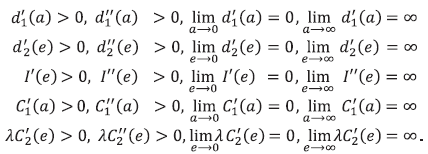
For these settings, we now consider the first best result from the maximization problem in (4).
|
| (4) |

Just like the central planner's problem, the objective function includes the social benefit of the infrastructure, B, and the social costs, CC, OC, d1 (a), and d2(e). Under Assumption 1, the objective function of the problem is concave, so we can find the optimal solution by deriving the first-order conditions:
| a: C'1(a*) + d'1(a*) = 1, | (5) |
| e: I'(e*) + λC'2(e*) + d'2(e*) = 1. | (6) |
Equations (5) and (6) show the first-order conditions for a and e. Equation (5) implies the marginal costs of decreasing CC should be the same as the marginal benefit of decreasing CC. When C increases the effort, a, both the disutility of C and the operating cost increase. Thus, the marginal social cost that includes the marginal OC and the marginal disutility of C (the left side of the equation) should be the same as the marginal benefit, which is 1, in social optimum.
Equation (6) implies the marginal cost of increasing the social benefit, B, should be the same as its marginal benefit. As the quality enhancing effort, e, increases, the social costs, including CC, OC, and the disutility of O, increase. In social optimum, the marginal social cost of enhancing the quality should be the same as its marginal benefit. In reality, however, we cannot achieve the first best result because of the conflict of interests among G, C, and O.