Designing Regulatory Systems for PPPs in Infrastructure Services
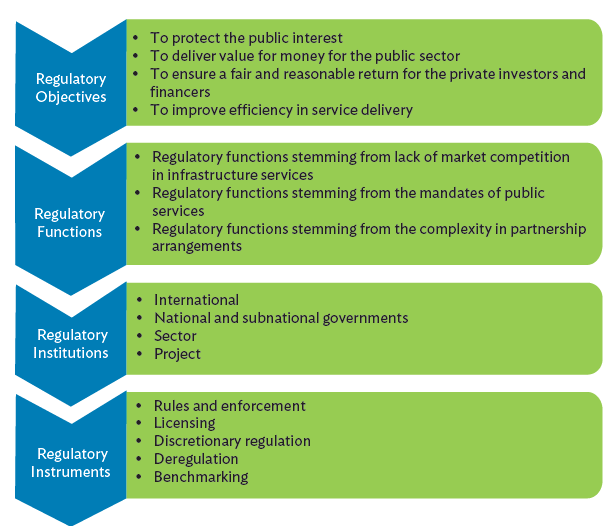
Figure 10.2 shows the main components of a regulatory system for PPPs in infrastructure services. Although these systems aim to protect against PPP risks, they carry their own regulatory risks. A poorly designed or functioning regulatory framework can expose the system to additional risks, while contributing little to mitigating the very risks that it is designed to counter. The framework shown in the figure provides a diagnostic tool for identifying pitfalls in designing regulatory systems that can help avoid these risks.
Figure 10.2: Key Components for Desiģning a Reģulatory System
for PPPs in Infrastructure Services
Source: Author.
In designing a regulatory system for PPPs in infrastructure services, the following questions should be addressed:
• What are the regulatory objectives, stated or assumed?
• Are the main regulatory objectives included?
• What is the relative importance of different objectives?
• How are regulatory functions linked?
• How can regulatory functions contribute to project performance?
• Are these regulatory functions equally important across different types of infrastructure services?
• Which government institutions should carry out regulatory functions and at what level?
• What types of regulatory instruments are best used for a particular regulatory function?
• Is the mix of regulatory instruments optimal?
The answers to these questions could reveal potential pitfalls in a regulatory system's design. The following looks at several notable pitfalls, which are relevant in Asia and globally.
Neglecting regulatory issues. Regulation is often not explicitly mentioned in guidelines or references for PPPs, in part because potential regulatory issues for PPPs tend to be framed in the context of contract design and contract management. But this omission risks underestimating the problems of regulating PPPs in infrastructure services, and the mismatch between these problems and tools used to tackle them.
Measures lacking for implementing regulatory objectives. These objectives will only be achieved if they are realized through regulatory functions that can be performed by using the regulatory instruments of one or more regulatory institutions. For example, price regulation by using price caps or cost-of-service regulations by an independent regulatory agency are essential for fulfilling the objective of better service delivery.
Poorly executed regulatory functions. As mentioned earlier, promoting PPPs for infrastructure services calls for rebalancing different regulatory functions, but regulation is a new functional area for many developing countries, and the complexity and capacity requirements for this are often greatly underestimated.
Failure to deal with conflicts. Conflicts are unavoidable among different regulatory functions and need to be sorted out in the design of PPPs for infrastructure services. For example, while the removal of restrictions on ownership types and structures of bidders may enhance market competitiveness, these restrictions are often seen as performing a key function in safeguarding a government's mandate to provide public services.
Misaligned regulatory functions. Regulatory functions performed by different regulatory agencies might be misaligned. For example, economic regulation can be carried out at the sector or project level, and disputes can be resolved by local or international courts of appeal. In a few developing countries in Asia, including Kazakhstan and Malaysia, PPP regulations are issued by national entities, such as PPP units, but their monitoring and enforcement can be done at the subnational or sector level. The choices on these issues may have significant effects on a regulatory system's performance.
Conflicting regulatory functions. The regulatory functions of different agencies should not contradict each other. For example, the restriction on ownership structure-the percentage share allowed for private sector players, for instance-might be removed from national regulation, but continues to apply at the sector level.