Case Study of a Pro-Poor PPP: Umbulan Water Supply System Project
This project, in East Java Province, aims to provide water services to the poor at an affordable price. Only 75% of the province's population is served by a water supply system, and expanding coverage is essential to the national government's objective to reduce poverty and inequality.
The initial idea for Umbulan goes back to the 1970s, but it was not until 2010 that it was tendered, with procurement completed in 2015. That the project finally got underway was because the national government registered it as a national strategic and priority project. The project was led by the coordinating minister for economic affairs. Project stakeholders include an SOE in infrastructure financing, PT Sarana Multi Infrastruktur; the Province of East Java; and cities and municipalities in the service area.
The project aims to serve 1.3 million people in the province with 93 kilometers of water transmission pipe, at an estimated cost of Rp2.05 trillion ($143 million). Because local governments and a private consortium of local companies were only able to finance 60% of the project, the national government provided fiscal support in recognition of the project's importance to its poverty-alleviation goals, and to make this a showcase PPP. The Ministry of Finance provided Rp818 billion ($57 million) through viability gap funding to ensure an affordable tariff for the water. SOE Sarana Multi, through the Project Development Facility, helped the provincial authorities prepare and carry out project transactions. The provincial authorities, for their part, bought the land used in the project. The financing was structured to deliver a bankable and fiscally sound project, which reached financial close in December 2016.
The concession period is 25 years. The project is scheduled to start operating in mid-2019, its revenue stream coming from user fees. As well as the national government's direct contribution through the Ministry of Finance, the Indonesia Infrastructure Guarantee Fund, an SOE providing guarantees for contingent liabilities, provided a guarantee to enhance the credit of the special purpose company. Figure 11.5 shows the project's transaction scheme.
Once the project is operational, there will be a substantial decline in water tariffs that will make the supply of clean water far more affordable in the service area. The local water company currently sells water at Rp3,331 per cubic meter (m3) ($0.25) but cannot meet the demand, and private suppliers at Rp36,000/m3 ($2.70) or nearly 11 times the local water company's price. The new price proposal after the project's completion ranges from Rp2,510/ m3 ($0.20) and Rp6,860/m3 ($0.50), depending on the distance from the plant.
The Umbulan Water Supply Project offers several lessons for promoting pro-poor infrastructure PPPs in Southeast Asia. It shows that well-led coordination among stakeholders can get long-delayed projects moving, as this one was. The project is a good example of the benefits of credit-enhancement and fiscal support through viability gap funding-made possible by the issuance of various regulations and decrees, including a presidential regulation. Registering Umbulan as a national strategic project and priority project showed the strong commitment of the national government to this project. That commitment, however, is hard to secure if the number of projects exceed a government's capacity to handle them; hence, it is essential to provide a feasible project pipeline. The project also highlights the importance of doing a thorough feasibility study; Umbulan's was done with the assistance of an SOE, which contributed to the project's financial structuring to make it bankable.
Figure 11.5: Umbulan Water Supply Project Transaction Scheme
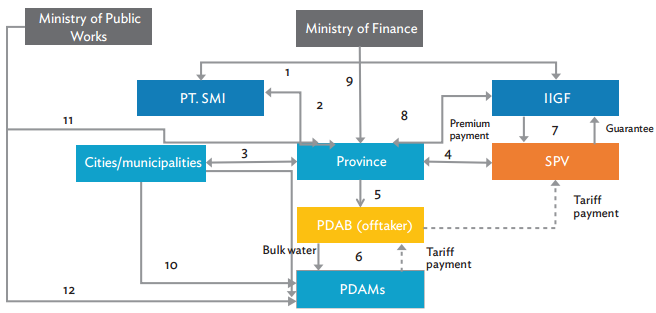
IIGF = Indonesia Infrastructure Guarantee Fund, PDAB = Perusahaan Daerah Air Bersih (regional bulk water company), PDAM = Perusahaan Daerah Air Minum (local water company), PT SMI = Sarana Multi Infrastruktur, SPV = special purpose vehicle.
Notes:
1. Assignment from finance minister to PT SMI to do project preparation
2. Cooperation between provincial government and PT SMI to facilitate project preparation
3. Cooperation between provincial government and municipalities/cities
4. Build-operate-transfer contract between provincial government and the SPV
5. Assignment from provincial government to PDAB to become offtaker
6. Bulk water supply contract between PDAB and PDAMs
7. Guarantee agreement between IIGF and SPV
8. Regress agreement between provincial government and IIGF
9. Viability gap funding provided
10. Support from municipalities/cities to PDAMs for bulk water payment
11. Support from the Ministry of Public Works in the form of partial construction, if needed
12. Support from the Ministry of Public Works to PDAMs
Source: Provincial Government of East Java. 2016. Mengalirkan Air Umbulan Sejahterakan Masyarakat. Surabaya.