Roles and responsibilities
1.6 The Department for Transport (the Department) and Transport for London (TfL) jointly sponsor and oversee the Crossrail programme. Crossrail Ltd is a company wholly owned by TfL and is responsible for delivering the programme safely to cost and schedule. The project development agreement sets out sponsors' high-level requirements for Crossrail, such as service frequency and service levels, as well as the programme's governance and delivery structure (see Figure 2).
1.7 The Department and TfL jointly fund the programme. The overall amount of available funding has changed over time. Figure 3 on page 14 shows the main sources of funding for the programme and how they have changed over time. The funding for Crossrail does not include the cost to build and maintain trains and a maintenance depot, which amounts to an upfront capital cost of around £1 billion, funded by TfL.
1.8 Throughout 2018, the programme began showing signs of distress, until eventually it became clear that the programme could not be delivered as planned. In a written ministerial statement in July 2018, the government announced that a further £590 million would be made available to address cost pressures on the programme. This was followed shortly after by Crossrail Ltd's announcement in August 2018 that it would not be able to open the central section of the railway in December 2018 as planned.
1.9 In response, sponsors commissioned a series of reviews by KPMG into the finance and commercial position and governance of the programme. In December 2018, the emerging findings of the finance and commercial review stated that up to an estimated £2 billion of additional funding would be needed to complete the railway, based on a high-level assessment of Crossrail's management information. In the same month, Crossrail Ltd announced that it could not commit to an opening date for the railway at that time.
| Figure 2 |
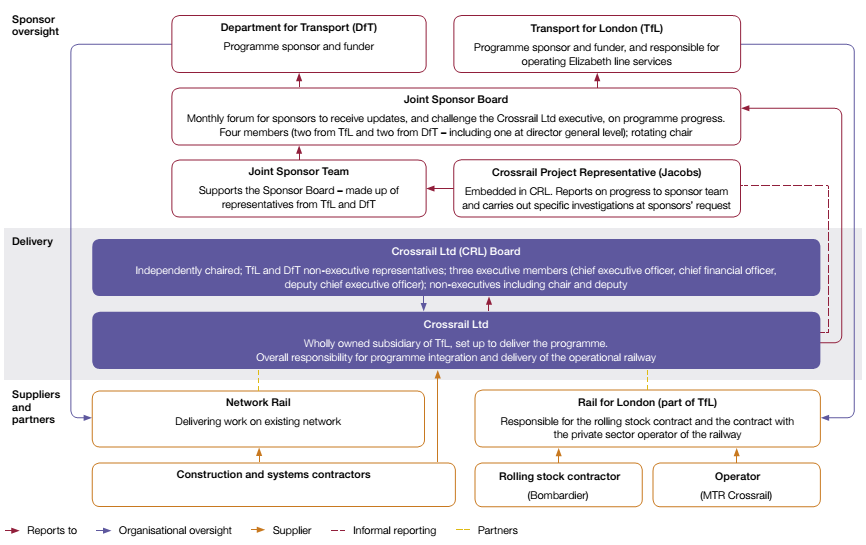
| Source: Comptroller and Auditor General, A memorandum on the Crossrail programme, Session 2017-2019, HC 1924, National Audit Office, February 2019 |
| Figure 3 | |
| Date | Event |
| 2007 | Government announces a funding package of £15.9 billion, with expected contributions of £5.2 billion from the Department for Transport (the Department), £2.4 billion from Transport for London (TfL), £2.3 billion from Network Rail and £6 billion from businesses. |
| 2010 | Through the Comprehensive Spending Review Crossrail Ltd reduced costs to £14.8 billion by simplifying and resequencing works, agreeing lower contractor prices, and adjusting forecasts in line with the effects of the economic recession. Crossrail Ltd also extended the timetable for full opening from May 2018 to December 2019, to reduce the amount of contingency needed. |
| July 2018 | Written ministerial statement announces an additional £590 million of funding to cover cost pressures on the programme: £300 million for Crossrail Ltd, funded jointly by TfL and the Department, and a further £290 million from the Department for Network Rail's works. |
| December 2018 | A new funding package for the programme is agreed, comprising loans from the Department of £1.3 billion to the Greater London Authority and £750 million contingency to be made available to TfL, as well as a £100 million cash contribution from the Greater London Authority. |
| 2019 | Loan funding begins to be drawn down. |
| 2031 | Latest point for Greater London Authority loan to be fully repaid. |
| 2033 | Latest point for TfL loan to be fully repaid. |
| Source: National Audit Office analysis of information from the Department for Transport, Transport for London and Crossrail Ltd | |
1.10 The Committee of Public Accounts took evidence on the delivery of the Crossrail programme in March 2019. The Committee questioned the Department and Crossrail Ltd on the warning signs that the programme was not delivering to plan, what actions the sponsors took to intervene in the programme, the causes of the cost increases and delays, and the risks of further funding for the programme being required.