Why costs have increased
2.8 Costs have increased on main contracts for a range of reasons. As on any major project delivered through a set of contracts, the common features of the causes of cost increases are change and delay. Crossrail Ltd's reporting of the causes of cost increases between 2013 (the time that we carried out our previous study on the programme) and November 2018 divide the reasons for increases in cost into four main categories: design change; the settlement of contractual 'compensation events'; acceleration or changing the sequencing of works to improve confidence in delivering on schedule; and additional scope. By 2018, these changes had resulted in more than £2.5 billion of increased contract costs funded in part from programme contingency (Figure 5).
| Figure 5 Costs have increased due to programme changes and delays |
| Cause of cost change | Description | 2013 -14 (£m) | 2015-16 (£m) | 2017-18 (£m) | Total (£m) |
| Design change | Changes to the design of specific elements of the construction and fit-out of tunnels and stations. | 277 | 213 | 225 | 714 |
| Commercial settlement | Settlement of commercial 'compensation events' due to, for example, delays to contractors' planned start dates. | 0 | 788 | 148 | 936 |
| Schedule change | Re-ordering of works and acceleration of works to bring work in line with target completion dates. | 190 | 83 | 53 | 326 |
| New scope | Changes to the scope of the Crossrail programme that were agreed between sponsors and Crossrail Ltd, mainly in the early stages of the programme. | 193 | 4 | 0 | 198 |
| Other | Includes, for example, the net impact of other increases and reductions in scope and cost increases due to unexpected site conditions. | 241 | 26 | 70 | 337 |
| Total |
| 901 | 1,114 | 496 | 2,511 |
Notes
1 The cost increases shown in the table represent costs that Crossrail Ltd had recognised as part of its overall budget. They exclude provision for risks of future cost increases.
2 All values are in cash prices.
3 Totals may not sum due to rounding.
| Source: National Audit Office analysis of Crossrail Ltd's semi-annual construction reports, June 2013 to November 2018 |
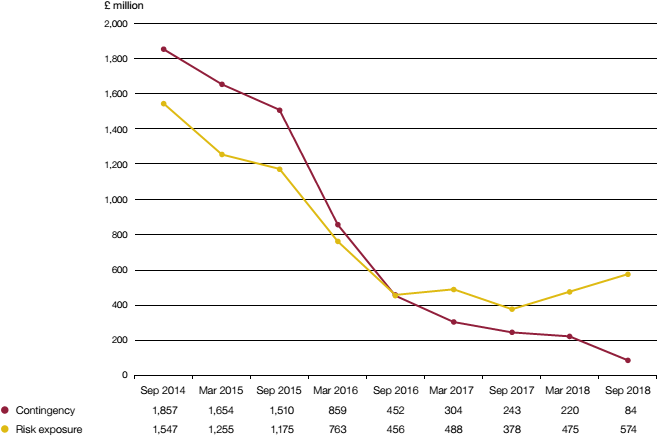
2.9 The increase in costs across the programme, particularly the impact of settling compensation events during 2015 and 2016 resulted in substantial drawing down of Crossrail Ltd's centrally held contingency, which Crossrail Ltd had set aside to manage such risks. By November 2016, Crossrail Ltd had drawn down substantial contingency and its risk exposure exceeded its centrally held contingency. It was also forecasting that it would need to draw on the £600 million of remaining contingency funding available to the programme, which was held by TfL (Figure 6).
2.10 A further increase in costs followed Crossrail Ltd's announcement in August 2018 that it would not complete the programme in time to open the central section in December 2018. This is because the extension of the programme schedule meant that contractors would be mobilised for longer than anticipated and Crossrail Ltd began to develop more realistic forecasts of what it would cost to complete the programme.
| Figure 6 Crossrail Ltd's contingency fund has steadily diminished to the point in September 2016 where quantified risks first exceeded Crossrail Ltd's centrally held contingency |
Notes
1 The value of the risk is given at 50% confidence, meaning there is a 50% likelihood of risks materialising at that cost or lower.
2 All values are in cash prices.
| Source: National Audit Office analysis of Crossrail Ltd reports |