The delivery and commercial strategy
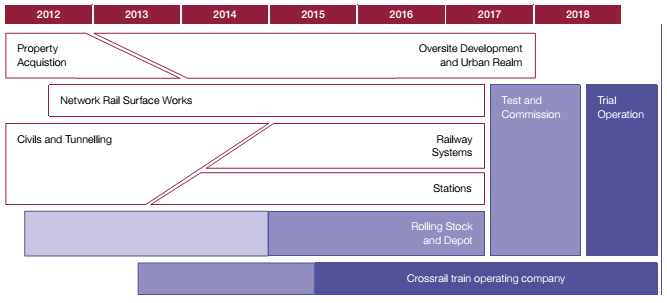
2.16 A defining feature of the Crossrail programme from an early stage has been the commitment of sponsors and Crossrail Ltd to stick to their public target of opening the central section of the railway in December 2018. At an evidence session of the Committee of Public Accounts on 6 March 2019, the current chair of Crossrail Ltd stated that there was "extreme commitment within the project" to meeting the opening date. Given the scale and complexity of the programme, Crossrail Ltd sequenced the main elements of the programme into overlapping phases of activity. This approach meant, for example, that stations would be constructed while tunnels were being bored and fitted out, and that multiple strands of activity, including installation of systems required to operate the railway and completion of stations, would take place at the same time during the latter stages of the programme. A number of stakeholders we spoke to expressed the view that the Crossrail Ltd executive team both recognised the challenges but believed this was an exceptional team capable of delivering exceptional results and overcoming these challenges. Figure 7 shows Crossrail Ltd's high-level sequencing of main elements of the programme.
2.17 Crossrail is being delivered through contracts with private sector design, engineering, and construction companies and an extensive supply chain of small contractors and suppliers of equipment and specialist skills. In 2008, Crossrail Ltd produced a delivery and procurement strategy, which included the key features of the commercial and contractual approach. Crossrail Ltd's commercial approach was dictated by, for example, the scale of the programme; however, it also introduced high levels of risk related to design and delivery, and interface risk that Crossrail Ltd would have to manage itself. Box 1 on page 24 sets out the key features, rationale and risks of the commercial and contracting approach.
| Figure 7 Multiple activities would take place at the same time |
Note
1 Oversite Development and Urban Realm refers to works to develop sites above and around stations.
| Source: Crossrail Ltd |
| Box 1 Crossrail Ltd's commercial and contracting approach The commercial approach introduced risks to the programme |
| The approach | Rationale | Risks |
| Contractual packages Award 36 separate main contracts for the main works, including separate contracts for each individual station and a range of system-wide contracts. |
Crossrail Ltd went for a large number of main contracts because of the size and complexity of the Crossrail programme. |
The number of contracts created high numbers of commercial interfaces to manage. Crossrail Ltd felt that it was best placed to manage these interface risks rather than rely on and incentivise main contractors to manage them in the supply chain |
| Design strategy Awarding contracts to build the main tunnelling and civil engineering works based on detailed designs developed by Crossrail Ltd, but awarding contracts to both design and build the systems required to operate the railway and stations, based on a high-level conceptual design developed by Crossrail Ltd. |
Crossrail Ltd decided not to develop a detailed design for all the contracts to fit-out stations and tunnels and install systems because it wished to benefit from involving contractors in the process from an early stage. |
The approach introduced the risk of conflicting designs between contractors and the potential for contractual change and delays while design work is resolved. Because Crossrail Ltd was responsible for integrating the overall programme, it bore much of the risk and impact of cost increases resulting from inconsistency of designs for different elements of the programme. |
| Train and signalling systems Sponsors decided that Crossrail Ltd should run the procurement of a contractor to design, build and maintain the class 345 trains, but that Rail for London, a subsidiary of TfL, would hold the commercial relationship with the contractor during the construction of the trains and their operational life. Crossrail Ltd procured and managed the contract to install and operate the signalling hardware at the trackside and developing signalling software required to communicate with the systems on the train. |
Sponsors considered that because TfL was paying for the trains and would be managing the contract with the supplier when they were operational, TfL was best placed to manage the contract. |
Having separate bodies hold the commercial relationships for two critically dependent contracts increased the challenge of managing them effectively. |
| Contractual form For 33 of the 36 main works contracts, Crossrail used a contractual form (the NEC 3 option C contract), which set a target price for the required work, supported by a schedule that set out the activities that contractors needed to complete. Financial risks are allocated through the stipulation that contractor and Crossrail Ltd would share equally the upside of any cost savings or the downside of any cost overruns relative to the target price. Crossrail Ltd chose to use fixed price contracts on works to transport excavated material from the construction sites by river to Wallasea, and to install platform screen doors in stations. |
Crossrail Ltd adopted this form of contract because, for example, it encouraged a collaborative relationship between client and contractor and early settlement of disputes, because it facilitated a fair allocation of risk, and because it had been used recently on the construction of the venues and infrastructure for the London 2012 Olympic and Paralympic Games. When events outside the contractor's control, such as unexpected ground conditions or scope changes occur, the contracts allow the contractor to raise compensation events to increase the target price. |
This form of contract depends on contractors meeting deadlines to handover work sites to other contractors to minimise the volumes of change and compensation events that require commercial agreement between parties. It also requires tight control and management by the client (Crossrail Ltd). |
Note
1 NEC is a family of contracts, developed by the Institution of Civil Engineers, that are designed to support project management and define legal relationships between client and contractor.
| Source: National Audit Office analysis |
2.18 Crossrail Ltd is responsible for managing and integrating the entire programme and providing TfL with an operational railway. In 2009, Crossrail Ltd awarded contracts to two project management companies to support it to manage the programme:
• In March 2009, Crossrail Ltd appointed Transcend Ltd, a joint venture between CH2M Hill, AECOM and Nichols Group, as the programme partner, responsible for strategic programme management. At the time of award, Crossrail Ltd estimated the cost of the contract to be around £100 million.
• In April 2009, Crossrail Ltd appointed a team led by Bechtel as its project delivery partner to act as lead contractor, responsible for coordinating the activities of other contractors on the central section of the railway. When it awarded the contract, Crossrail Ltd estimated that it would be worth around £400 million.
2.19 Rather than keeping its commercial project partners at arms' length and accountable for the overall delivery of the programme (as the Olympic Delivery Authority had done with its commercial delivery partner), in 2011, Crossrail Ltd integrated contractors from the two partner firms within the central Crossrail team. The objective was to create a seamless team to encourage collaboration and bring private sector expertise into the programme. Alongside its decision (Box 1 on page 24) to award 36 main contracts, this meant that Crossrail Ltd had few commercial levers to drive management and integration of the overall programme, and took on all the risk of doing so itself.