Increasing capacity and reducing congestion
One of the main objectives of Crossrail - and central to the business case for the programme - is the need to increase capacity on the underground and main-line rail network in London to meet future demand, thereby reducing congestion on some of the most overcrowded lines on the London Underground network. According to Crossrail Ltd's website, Crossrail will increase capacity on the rail network in central London by around 10%.
In 2010, the Crossrail business case forecast that London's population would continue to grow, with nearly 1.3 million additional people living in London and 750,000 new jobs being created between 2010 and 2031, and that annual growth in demand for peak-time public transport would increase to around 1.5% a year. At that time, Crossrail Ltd estimated that Crossrail would carry around 200,000 people each day during the morning peak.
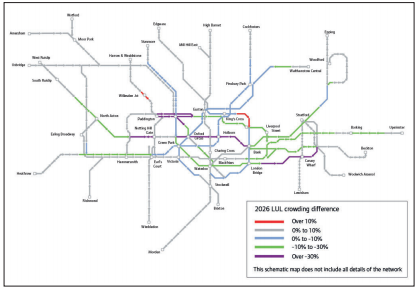
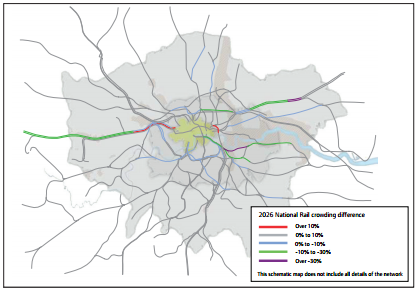
Figures 4a and 4b shown on the right, which are taken from the 2010 business case, show that Crossrail Ltd was forecasting that the introduction of Crossrail services to the network could result in peak-time reductions in overcrowding of between 20% and 60% on the Bakerloo, Central, District and Jubilee lines of the London Underground as well as reductions in overcrowding on the national rail network.
| Figure 4a London Underground crowding changes with Crossrail 2026
Source: Crossrail business case, July 2010. Available at: https://webarchive. |
| Figure 4b Rail crowding changes with Crossrail 2026
Source: Crossrail business case, July 2010. Available at: https://webarchive. |