Funding
The Authority has secured a total of $12.7 billion in funding and has identified an additional $15.6 billion in possible future funding for the high-speed rail system. Although the Authority completed some preliminary planning tasks in the years following its creation, it did not have a dedicated revenue stream until November 2008, when voters approved Proposition 1A, which provided funding for the system. Also known as the Safe, Reliable High-Speed Passenger Train Bond Act for the 21st Century, Proposition 1A allowed for the issuance of $9.95 billion in state general obligation bonds, $7.5 billion of which is for the system's planning and construction. Two years later, the State secured federal funding for the project through the American Recovery and Reinvestment Act (Recovery Act), which provided $2.6 billion through a matching grant.
Figure 1
Timeline of High-Speed Rail Development
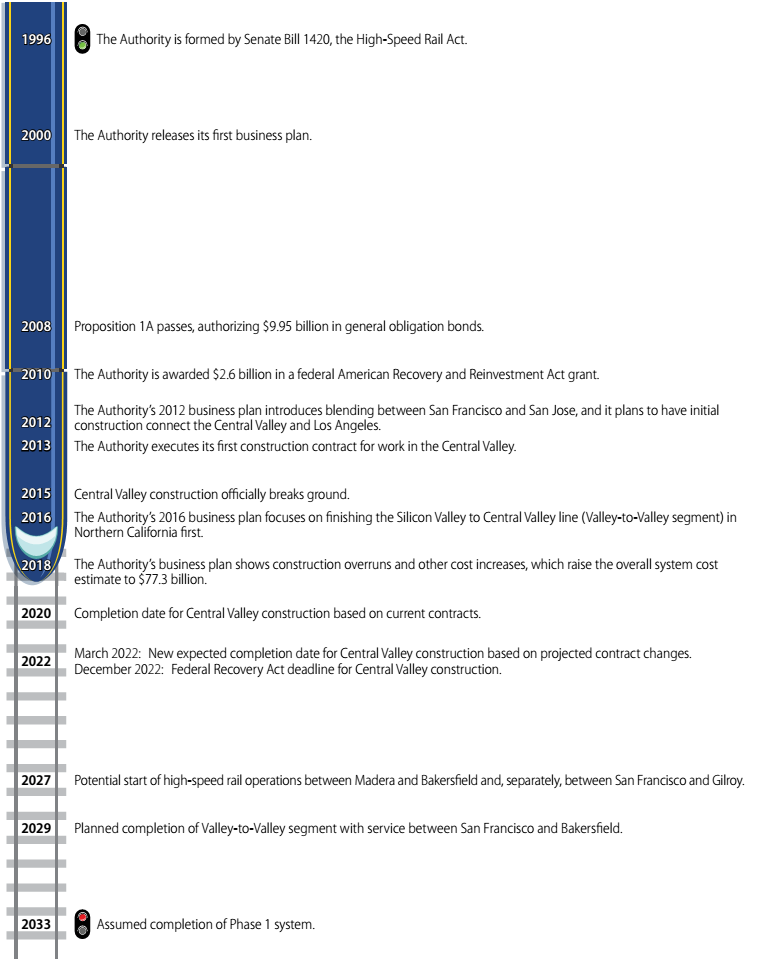
Source: State law, state election records, federal grant agreements, and the Authority's business plans, contracts, and press releases.
In 2011, the State received an additional $929 million in federal grant funding, bringing the total federal support to $3.5 billion. The Authority also receives a continuous appropriation of 25 percent of revenues from the State's Greenhouse Gas Reduction Fund, which is funded by the State's cap-and-trade program. As of December 2017, this funding stream had provided the Authority $1.7 billion, and the Authority projects it will receive between $4 billion and $4.5 billion in future revenues from the fund through 2030. The Authority also projects receiving an additional $3.9 billion to $11.1 billion if it is able to use federal loan programs or public-private partnerships to borrow against future cap-and-trade revenue.
The Authority presented its most recent cost estimate for the system-$77.3 billion-in its 2018 business plan. The Authority stated in the 2018 business plan that it would continue to pursue all possible options for funding the project, including additional federal grants and private sector partnerships. However, these funding sources have not yet materialized. The Authority is also exploring additional funding scenarios with local governments in the cities and counties where it plans to build stations. In recognition of the expected economic impact of the new rail stations, the local governments that partner with the Authority would use future property tax revenues to help support the development of such stations within their jurisdictions. Although recent state legislation has expanded these types of funding options and the Authority has worked with cities to evaluate their feasibility, it is still in the early stages of this planning. Similarly, the Authority has researched the prospect of receiving advertising and station parking revenue in the future.