System Planning and Construction
According to its 2000 business plan, the California high-speed rail system was originally conceived as a stand-alone, dedicated system spanning over 700 miles and connecting some of the State's largest cities, including San Diego, Los Angeles, San Francisco, and Sacramento. Early plans for the system also called for stations throughout the Central Valley, including in Bakersfield and Fresno. Since that initial vision, the Authority's plans have changed dramatically. Most notably, in its 2012 revised business plan, the Authority introduced the concept of blending-the practice of sharing existing infrastructure with other rail operators instead of constructing dedicated infrastructure for high-speed trains-which partially offset the system's rising cost estimates. Although previous business plans had considered opportunities to integrate the system with other railways, the 2012 plan was the first time the Authority formally introduced blending into the system by deciding to share the corridor between San Francisco and San Jose with an existing regional carrier, Caltrain. Since then, the Authority has incrementally adopted blended options elsewhere in the system, including between Burbank and Los Angeles and-as it announced in its 2018 business plan-between San Jose and Gilroy. Figure 2 details how planned blending has expanded across portions of the system over time. We further discuss the projected cost savings associated with blending, as well as the service implications, in Chapter 1 of this report.
In the 2012 business plan, the Authority also announced that it would use a segmented approach to building the system, in part due to the lack of sufficient funding for the full system. The segmented plan initially called for the Authority to construct a segment between Merced and the Los Angeles basin on which it would operate high-speed service before completing the rest of the system. However, in its 2016 business plan, the Authority changed course and stated that it planned to build first between San Jose and an interim station north of Bakersfield, an approach the Authority has named the Silicon Valley to Central Valley Line (Valley-to-Valley segment). In 2018, the Authority announced that it would expand the planned Valley-to-Valley segment to San Francisco in the north and downtown Bakersfield in the south; previously, the southern terminus had been Shafter, a small farming community north of Bakersfield. However, the Authority's 2018 business plan acknowledges that although it has the funds necessary to complete work in the Central Valley between Madera and Bakersfield, as well as between San Francisco and Gilroy, the funds will not be sufficient to complete the tunnels necessary to connect those two lines or extend the system south to Los Angeles. Figure 3 on page 12 illustrates the Authority's current and projected funding as compared to the estimated cost of different segments.
Construction of the system is now underway in the Central Valley. Current construction is focused on developing the initial infrastructure, such as bridges and viaducts. Future construction will lay the physical track and will install other needed support services and maintenance facilities. As Figure 4 on page 13 shows, the Authority has divided its current construction into three projects, which this report refers to as Project 1, Project 2/3, and Project 4. The Authority has entered into contracts with different construction firms for the delivery of each project. These construction contracts represent $3.1 billion of the $5.6 billion in contracts that the Authority currently oversees. Chapter 1 of this report includes our review of each construction project, including its cost and status.
Figure 2
The Authority's System Plans for Phase 1 Have Evolved Over Time
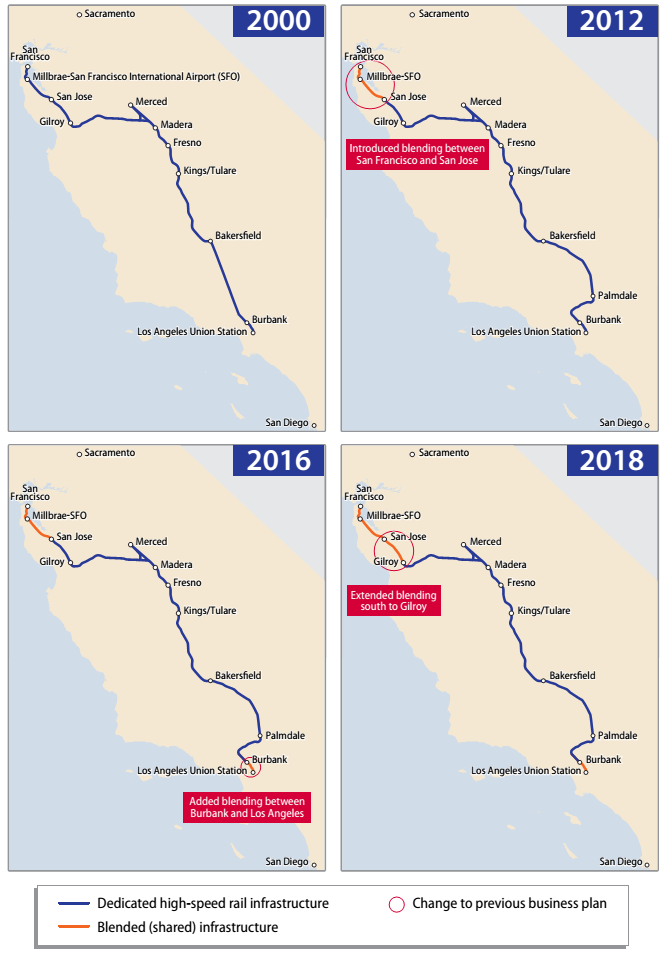
Source: The Authority's published business plans, budgets, and planning documents.
Note 1: The Authority has not consistently planned to operate service between Los Angeles and Anaheim. As recently as 2014, the Authority did not plan to operate trains on this segment. The Authority now plans to operate high-speed trains on this segment by sharing track with Metrolink. However, because these plans do not represent a shift from dedicated to blended infrastructure over time, this segment is not included in the above analysis.
Note 2: The Authority has consistently stated that it intends to eventually complete Phase 2, which will extend the system to San Diego (via the Inland Empire) and Sacramento after it finishes Phase 1 between San Francisco and Los Angeles. The maps above show Phase 1 only.
Figure 3
The Authority Has Secured Funding to Finish Construction in the Central Valley but Not the Rest of the System
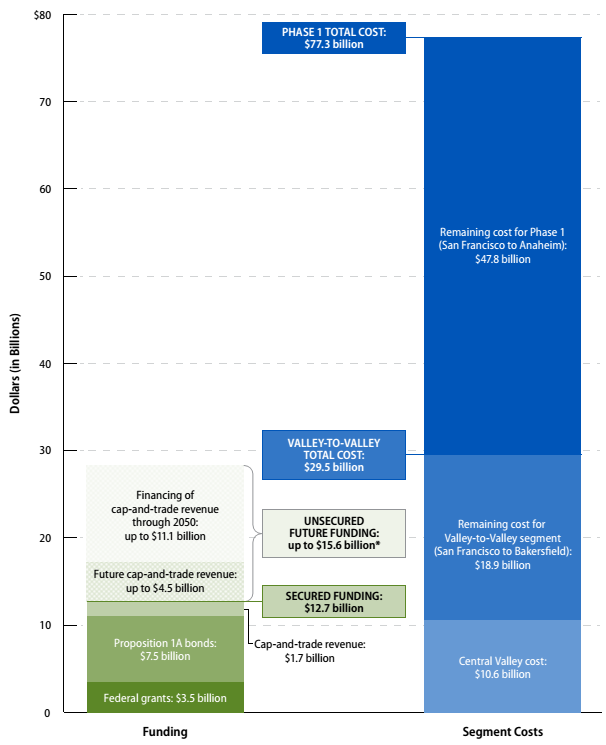
Source: The Authority's 2018 business plan.
* The Authority presents its unsecured funding in ranges. This graph uses the high end of its estimates; the Authority's low-end estimates of unsecured future funding is $7.9 billion.
Figure 4
Current Construction Projects Are Between Madera and Bakersfield
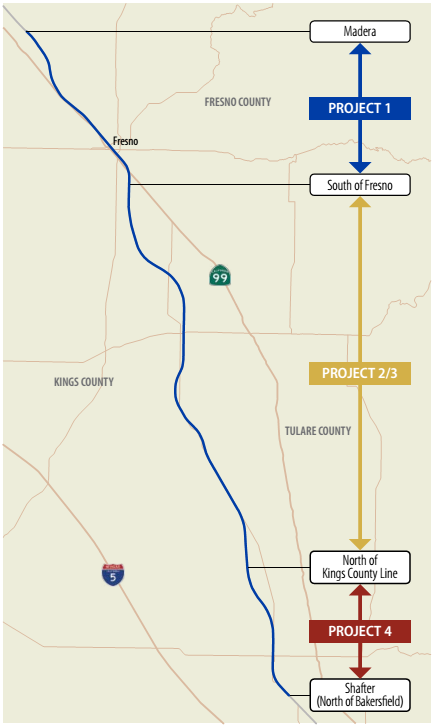
Source: The Authority's maps and construction contracts.