The Authority Did Not Sufficiently Account for Known Risks in Its Initial Cost Estimates
The Authority approved the start of construction in the Central Valley in 2013 despite knowing that moving forward was likely premature from a planning perspective and thus carried significant risks for unknown costs. According to its chief engineer, the primary factor in the Authority's decision to execute a construction contract in August 2013 was to meet deadlines for project completion and spending of funds under the terms of its 2010 grant agreement with the federal government. The agreement provided $2.6 billion for the project under the Recovery Act. Because the purpose of the Recovery Act was to create and preserve jobs and revitalize state and local economies, the agreement required that the Authority complete the Central Valley construction by 2017.2 In coordination with the federal government, the Authority determined that it needed to begin construction as soon as possible to meet that deadline. Therefore, the Authority executed its first construction contract in August 2013 and authorized the construction contractor to begin work in October 2013. Figure 6 on the following page details the three projects currently underway-all of which are funded in part by federal money-and provides a timeline of Central Valley construction.
The Authority did not complete many critical planning tasks before beginning construction, which ultimately resulted in significant delays and led to increased costs. Because the Authority's planning was incomplete, it has used change orders to direct its contractors to perform additional work and to compensate them for delays. Quantifying the total cost of the change orders resulting from the Authority's insufficient planning is difficult, largely because the Authority's change order summaries do not show which changes stemmed from the early start of construction. However, the majority of the change order costs relate to risk areas that the Authority had identified but not effectively quantified when it decided to move forward with construction. Some of these risks, such as not securing the property on which it intended to build, directly led to cost overruns and project delays. In other instances, the Authority did not sufficiently account for the costs arising from issues it knew it would eventually need to address, such as relocating utility infrastructure from project sites and addressing the concerns of external stakeholders. At the time, it indicated that it did not have the information or finalized agreements it needed to plan or budget for the mitigation of these issues. Figure 7 on page 27 summarizes the total impact that executed change orders have had on the three current construction projects in terms of cost and delay. |
|
Because the Authority's planning was incomplete, it has used change orders to direct its contractors to perform additional work and to compensate them for delays. | |
|
Figure 6
The Authority's Three Current Construction Projects Have Been Phased In but Share a Deadline
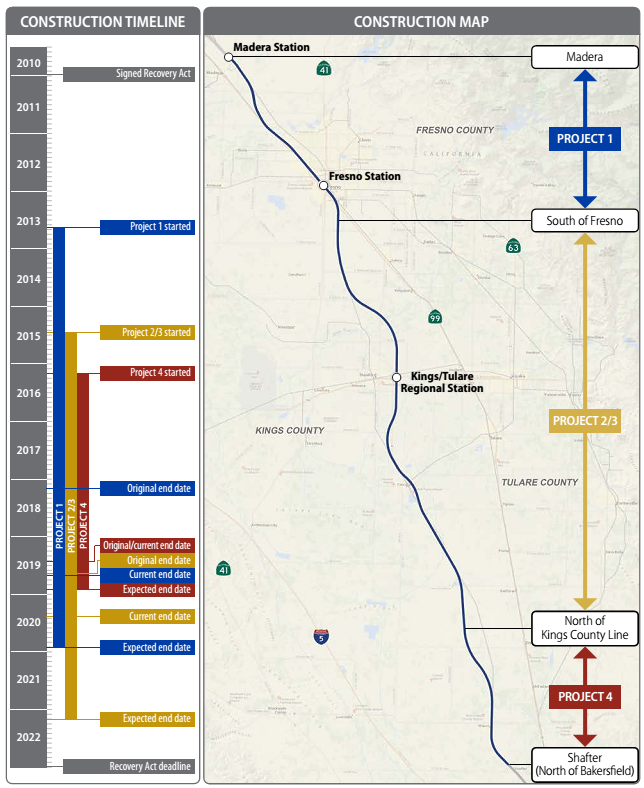
Source: The Authority's contracts, business plans, baseline schedules, and maps.
Figure 7
The Authority's Change Orders Have Increased the Cost and Length of Its Construction Contracts
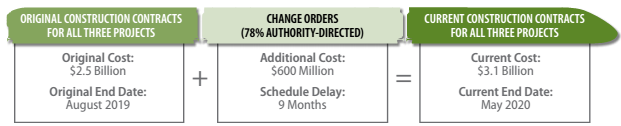
Source: The Authority's change order records and construction contracts.
___________________________________________________________________
2 As we discuss later in this chapter, the federal government extended this deadline to December 2022.