To Complete Construction of Its Three Current Projects, the Authority Believes It Will Need $1.6 Billion in Additional Change Orders and Extended Project Timelines
Baseline estimates that the Authority and its oversight firms provided to us in July 2018 indicate that the Authority will need $1.6 billion in additional change orders to complete the three current construction projects, for an anticipated total cost of $4.7 billion. These changes include additional costs for ongoing activities we discuss in the previous section, such as utility relocation and land acquisition. The $4.7 billion total also includes costs for new activities, such as construction of intrusion protection barriers and efforts to mitigate problems with soil stability in the Central Valley. According to the RDP consultants, who are responsible for coordinating the Authority's estimation process, the new baseline estimates represent a budget-and accompanying timeline-that the Authority believes is achievable and realistic, provided it takes appropriate actions as needed.
Because of these projected changes, the Authority will need to extend its schedule significantly. As of June 2018, the Authority had extended the contract completion dates for Project 1 from 2018 to 2019 and for Project 2/3 from 2019 to 2020. However, given the work needed to complete the anticipated $1.6 billion in additional change orders, the Authority's new baseline schedule indicates that it will need to extend the completion dates once again, with the latest-for Project 2/3-in March 2022. If the work does not progress as quickly as planned or if more changes become necessary, the Authority will likely need to push completion dates further into the future.
Additional delays to the three current construction projects pose their own significant risks for the Authority, which must finish the Central Valley construction by December 2022 to avoid violating its federal grant agreements. The Authority received two federal grants for the Central Valley segment, one under the Recovery Act for $2.6 billion and a second for $929 million. Violating the grant agreements could require the Authority to repay this $3.5 billion in federal grant funds, $2.6 billion of which it reports it has now spent. The Recovery Act grant agreement's deadline has been extended once before-from 2017 to 2022-at the Authority's request. The Authority has not indicated any plans to request a second extension or to request an extension for its other grant, and it has no guarantee it would receive such an extension if it asked. In a legal opinion, the GAO concluded that the federal government could require the State to repay all $2.6 billion of the Recovery Act funds if it determines the Authority has violated the agreement, and it could recover the funds by offsetting any other payments by the federal government to the State. Consequently, the Authority's 2018 business plan listed meeting the December 2022 deadline as its first priority.
| Earned Value Analysis According to the Project Management Institute, earned value analysis is a tool that allows entities to measure the progress of projects and to forecast their total costs and dates of completion. Planned value: How far along the project work is supposed to be at any given point in the project schedule and cost estimate. Earned value: Actual progress to date in terms of project schedule and cost. Source: Project Management Institute. | Meeting the federal deadlines for the Central Valley projects will be challenging and will require construction to occur significantly faster than it has in the past. Figure 8 illustrates how the Authority's change orders have added more work and extended the construction schedule over time. The Authority uses a project management tool called earned value analysis, which is described in the text box. Figure 8, which is based on this tool, demonstrates the Authority's planned and actual progress on its three projects. Change orders affect the planned schedule (blue line) by increasing the amount of work, which is expressed in terms of cost and time. As a result, the Authority's actual progress (yellow line) needs to accelerate from its historical average for the Authority to complete the three projects by the federal deadline. As the green line that represents the required rate to meet the December 2022 deadline demonstrates, finishing the projects in time will require the Authority to work twice as fast over the next four years as it has since it began construction in 2013. If the Authority continues to work at its current rate, it will not complete all anticipated work until 2027, as the red line in Figure 8 shows. Further, the federal grant requires the Authority to lay track across the segment, a task for which the Authority has not yet procured a contractor. It plans to lay the track concurrently with the current construction projects beginning in 2020. |
|
|
Figure 8
The Authority Must Double the Rate of Central Valley Construction to Meet the Federal Deadline
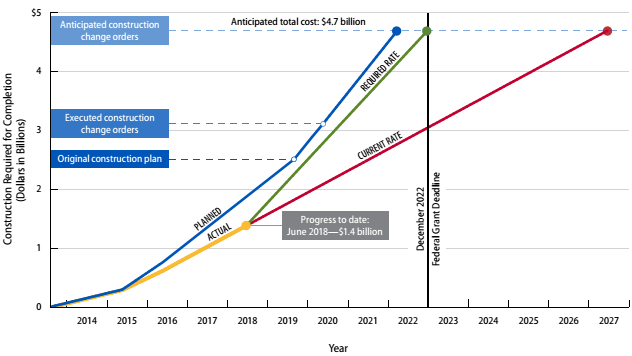
Source: Analysis of the Authority's estimates at completion, baseline schedules, construction contracts, monthly invoices, and monthly reports.
Note: This figure only presents information on Projects 1, 2/3, and 4, which cover project infrastructure between Madera and north of Bakersfield.
The Authority's recently adopted schedule predicts that it can finish on time, but only if it effectively monitors and mitigates risks. When presenting the new schedule to its board, the Authority's deputy chief operating officer stated his belief that the Authority can achieve the planned schedule, but he conceded that the approach is "very aggressive." For the Authority to effectively mitigate future problems and accelerate the rate of construction, it must have accurate, realistic information on all the risks it faces. According to the Authority's chief engineer-who oversees risk management for the system-the oversight firms play a significant role in the risk management process. However, as we discuss in detail in the next chapter, the Authority's management of its contracts with the oversight firms has been flawed. Further, when we asked about certain information that the oversight firms had provided through the risk management process, an RDP consultant responsible for managing the schedule stated that the firms' risk assessments were sometimes potentially misleading. He attributed this issue to the Authority not always closely or consistently monitoring the oversight firms.
| As the cost overages and delays the Authority has experienced in the Central Valley to date demonstrate, insufficient risk identification and management can have serious implications. | As the cost overages and delays the Authority has experienced in the Central Valley to date demonstrate, insufficient risk identification and management can have serious implications. If the Authority allows deficiencies in its risk assessment process to continue, it may not properly identify and respond to threats to the system's development. This could in turn prevent the Authority from meeting its December 2022 deadline. |