An overview of cloud services
Cloud services are provided through the internet. This contrasts with traditional systems with hardware and software on an organisation's own premises. Cloud services are not a new concept. An early example was email accessed through a web browser. Today better and faster internet connections create new opportunities for cloud services, which are available in an increasing range of areas, including business and financial systems.
Cloud services are being heavily promoted as providing a wide range of benefits, including efficiency, flexibility and security. These benefits may be achieved through the cloud provider's economies of scale and expertise.
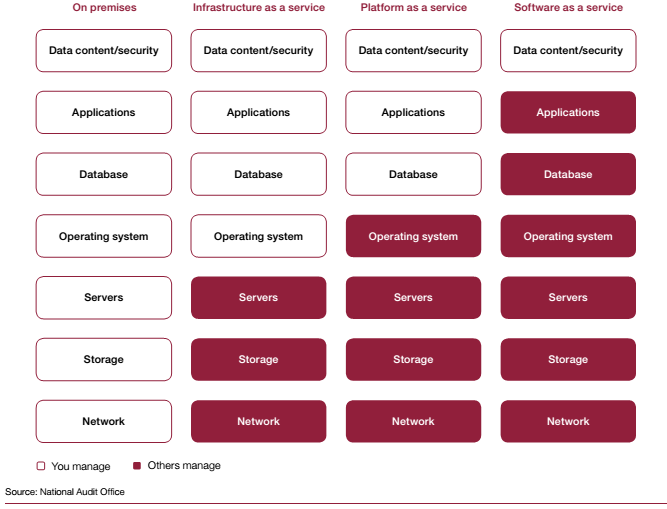
Figure 1 overleaf sets out the different levels of cloud service and gives examples of each. In some cases it is no longer necessary to have the data storage, servers, software or digital team on an organisation's own premises. The three basic levels of cloud service are:
1 Infrastructure as a service (IAAS). This provides the base layer of computing infrastructure. It is suited to users who need access to high levels of capacity for their own systems, for example computationally intensive research. Examples include Microsoft Azure, Google Cloud Platform and Amazon Web Services (AWS).
2 Platform as a service (PAAS). This provides the computing infrastructure plus the operating system and databases. This option works for organisations who want to run their own software on a cloud platform. Examples include Microsoft Azure and Heroku.
3 Software as a service (SAAS). This delivers fully featured applications over the internet. Customers do not need to install or maintain software or have their own hardware. However, it gives the least amount of control over updates and changes to features. Examples include Microsoft Office 365, Google Apps, Oracle Fusion Cloud, SAP S/4HANA Cloud, Salesforce.
Not all cloud services are necessarily described in the above manner. For example, the G-Cloud framework categorises services as cloud hosting (infrastructure and/ or platforms), cloud software and cloud support (that is, to help set up and maintain a service).
Figure 1
Comparison between on-premises and different levels of cloud service
The three levels of cloud service outlined above may be provided on the following types of 'cloud':
• Public cloud - the cloud provider owns and runs the cloud systems, delivering services over the internet. Many customers (known as 'tenants') share the same hardware, storage and network devices.
• Private cloud - the cloud provider gives a single customer dedicated use of specific cloud systems. This provides enhanced control over the environment as the resources are not shared with others. This option is more expensive.
• Community cloud - an extension of the above whereby a dedicated service is shared between a limited community of organisations with common requirements around security, privacy, performance and compliance and who bear the costs of the service. It is generally the responsibility of the community itself to determine who it wishes to admit.
• Hybrid cloud - this is a combination of the above where some applications and services are run in a public cloud and others in a private cloud. These can be complex and challenging to create.