The Department's aircrew requirements
1.2 The Department must train aircrew to fly and operate around 25 types of front-line aircraft currently in use by the three front-line commands - the Royal Navy, British Army and Royal Air Force (RAF). Over the 10 years from 2018-19, it plans to invest £46 billion in procuring and supporting aircraft, which must then have suitably trained aircrew. These include pilots to fly all types of military aircraft from fast jets (including Typhoons and F-35 Lightnings), large aircraft and helicopters, as well as specialist rear crew to undertake a variety of technical roles.
1.3 In April 2019, the RAF, which has a higher demand for pilots than the Navy and Army, was 18% (331) below its requirement for 1,869 pilots. In 2018, we reported that at the current rate of training, the RAF estimated it would be another 20 years before it has enough pilots.7 Since then the Department has been considering ways to increase the number of trained aircrew, which we describe in Part Three.
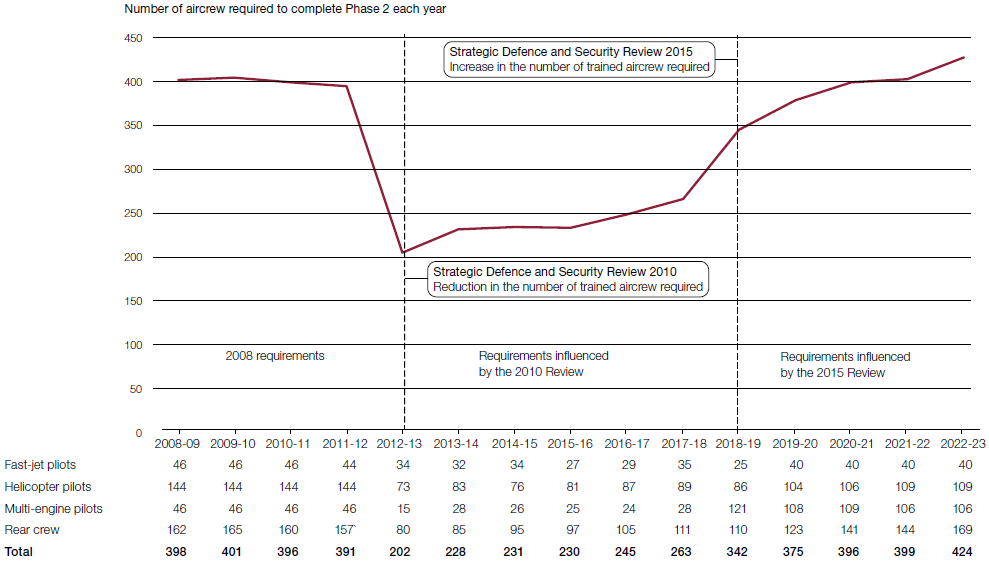
1.4 The Department's front-line requirements, set by each command, direct the number and type of aircrew to be trained each year (Figure 2). Every five years, through Strategic Defence and Security Reviews, the government sets the strategic context around these requirements. As such these Reviews, last conducted in 2010 and 2015, influence the number of front-line aircraft in service and therefore the aircrew requirements.
1.5 Changes introduced by the Strategic Defence and Security Review 2010 (2010 Review) decreased the number of aircrew required, resulting in a 48% (189) fall in the aircrew who needed to complete Phase 2 training in 2012-13. This followed certain aircraft being removed from service and the retirement of others earlier than expected.
____________________________________________________________________________________________
Figure 2
Ministry of Defence requirement for students completing Phase 2 training, 2008-09 to 2022-23
The Ministry of Defence's aircrew requirements have changed over time
Number of aircrew required to complete Phase 2 each year
Notes
1 From 2018-19, multi-engine numbers include those training to fly remotely piloted aircraft (drones).
2 The 2010 Review reduced aircrew requirements following certain aircraft being removed from service and the retirement of others earlier than expected. The 2015 review increased requirements with, for example, the Department purchasing more aircraft and extending the lives of others.
Source: National Audit Office analysis of Ministry of Defence data
____________________________________________________________________________________________
1.6 Subsequently, the Strategic Defence and Security Review 2015 (2015 Review) increased requirements. This included the Department committing to: two additional Typhoon fast-jet squadrons; accelerating the purchase of F-35 fast jets; purchasing nine new maritime patrol aircraft; acquiring remotely piloted aircraft; and extending the life of some existing surveillance aircraft. Prior to the 2015 Review, the Department's expected Phase 2 training requirement for 2018-19 was 266. After the 2015 Review, this increased by 29% (76) to 342 for 2018-19).
______________________________________________________________________
7 Comptroller and Auditor General, Ministry of Defence, Ensuring sufficient skilled military personnel, Session 2017-2019, HC 947, National Audit Office, April 2018.