Training times
1.10 The Department does not collect data centrally on how long training takes for students across the front-line commands. Data from the RAF indicate that as at July 2019, the average time taken by RAF students to complete the three-phase training was far longer than expected (Figure 4 overleaf). The Department told us this reflects that the overall training system does not currently have the capacity to handle the required throughput and that managing students through the three-phase process remains a challenge.
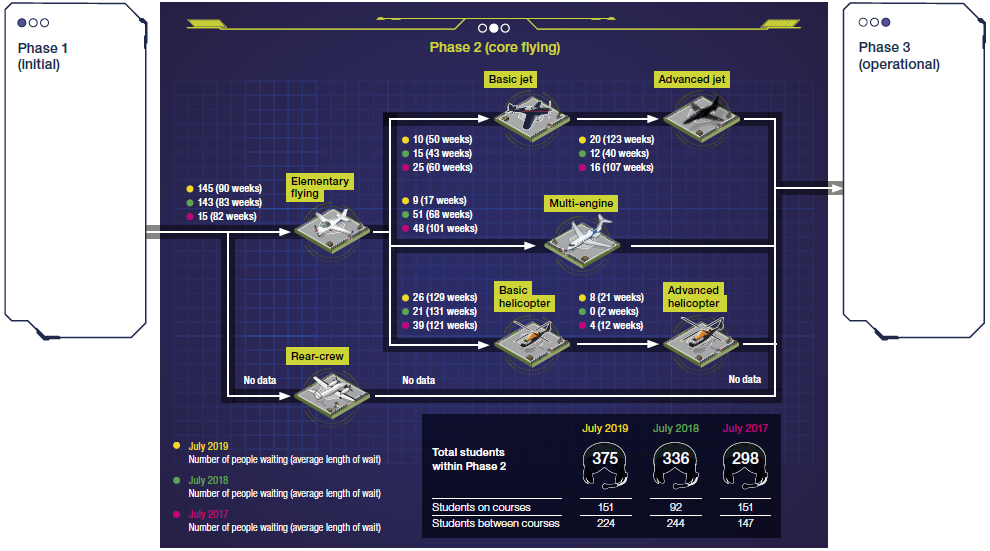
1.11 The Department recognises that the full training process currently takes students longer than anticipated. Students spend longer between individual courses, termed 'being on hold', than the Department expected. It always planned to have students waiting in order that courses were full, with an optimum one-month wait between different courses. In July 2019, 145 RAF students were due to start a Phase 2 course, compared with 151 undertaking training courses (Figure 5 on page 17). By managing the number of new students entering Phase 1, the Department expects those waiting to decrease by 10% during 2019-20, with the backlog at planned levels by April 2021.
____________________________________________________________________________________________
Figure 4
Average actual and optimum Royal Air Force pilot training time in July 2018 and 2019
The time taken to train aircrew has consistently exceeded the Ministry of Defence's expectations
| Aircrew type | Ministry of Defence's optimum time (years) | Average time as at July (years) | |
| 2018 | 2019 | ||
| Fast jet | 3.9 | 7.4 | 7.1 |
| Multi-engine | 2.6 | 4.3 | 4.5 |
| Helicopter | 3.0 | 5.0 | 5.2 |
Notes
1 Training time is measured from the start of Phase 1 to the end of Phase 3 training. Optimum times reflect the average target time once the Military Flying Training Scheme (the MFTS) is fully implemented, assuming no more than a month between courses.
2 Actual times taken from the Ministry of Defence's (the Department's) student database, which it uses for internal reporting. This database does not reconcile with the Department's manual record of students completing training and we have been unable to quality-assure these data.
3 Data do not include Army and Navy students. They include all Royal Air Force students training via both the MFTS and other courses. No earlier information is available, and the Department does not collect data on rear crew as this training is currently conducted through a range of training packages.
Source: National Audit Office analysis of Ministry of Defence data
____________________________________________________________________________________________
1.12 In April 2019, the RAF was a total of 1,750 personnel below its required strength. Students between courses fll various roles which would otherwise be vacant.
In 2018-19, the salaries of student aircrew working in other areas, such as air traffic control, air safety assurance and air worthiness, amounted to £8.5 million. Waiting to undertake training can affect morale but the Department told Parliament that in 2018 fewer than 10 people left the Armed Forces before completing their flying training, which would be less than 3% of 375 students in Phase 2 training as at July 2019. It does not systemically collect data on student aircrew morale or retention.
1.13 The Department selects students and provides the necessary initial training before they join Phase 2 training. In 2016, the Department recognised there were delays introducing new training and that it did not yet have plans to deliver its current aircrew requirements. In 2016-17, the RAF selected 69% (92) more student aircrew than in 2015-16. This decision did not take account of training capacity and contributed to an increase in students waiting to start Phase 2 training. As at July 2019, 145 RAF students had been waiting an average of 90 weeks, compared with 15 students waiting 82 weeks in 2017. The Department prefers to keep students waiting in advance of starting Phase 2 training, rather than after they have developed aircrew skills that would then need to be refreshed. In 2019-20, the RAF aims to recruit 146 aircrew, 73 (33%) fewer than in 2016-17. By the end of 2020-21, the Department expects 26 students to be waiting an average 12 weeks to start Phase 2.
____________________________________________________________________________________________
Figure 5
Royal Air Force students across Phase 2 of the military flying training process in July of 2017, 2018 and 2019
The numbers of students waiting to start elementary flying training and the time students are waiting has increased since 2017
Notes
1 Actual times taken from Ministry of Defence's (the Department's) student database, which it use: for internal reporting. This database does not reconcile with the Department's manual record of students completing training and we have been unable to quality-assure these data.
2 Data do not include Navy and Army students. They include all Royal Air Force students training via both the Military Flying Training System and other courses.
3 Total students between courses includes those completing elemtary flying training who have not yet been assigned a specific training route (two as at July 2018; four as at July 2019).
4 The Department does not have robust data to show students waiting for Phase 3 training before 2018 or undertaking rear crew training.
Source: National Audit Office analysis of Ministry of Defence data
____________________________________________________________________________________________