The Military Flying Training System
1.14 In 2008, the Department signed a 25-year contract with Ascent, a 50:50 Lockheed Martin and Babcock joint venture, to design, introduce and then manage with the Department new Phase 2 training. It decided to outsource this training following Departmental and National Audit Office work, which highlighted that existing training was fragmented and expensive and that students spent too long in training rather than on the front line.8 The Department's aims in using an external provider were to:
• optimise training times;
• close the gap between the skills of aircrew finishing training and the skills needed to use front-line aircraft; and
• reduce the overall cost of flying training.
1.15 The Department has been transitioning to the MFTS incrementally, with Ascent introducing training in phases for different aircraft types. Each training package includes individual courses, which students must finish to complete Phase 2. During the transition, the Department continued to operate legacy training and support older aircraft, and has used other training providers outside the MFTS. The Department expects the first students trained entirely through the MFTS to graduate in September 2019. Until then it will be difficult for the Department to start to assess whether MFTS students perform better during Phase 3. If so they may need to undertake less of this operational training, reducing the overall training cost.
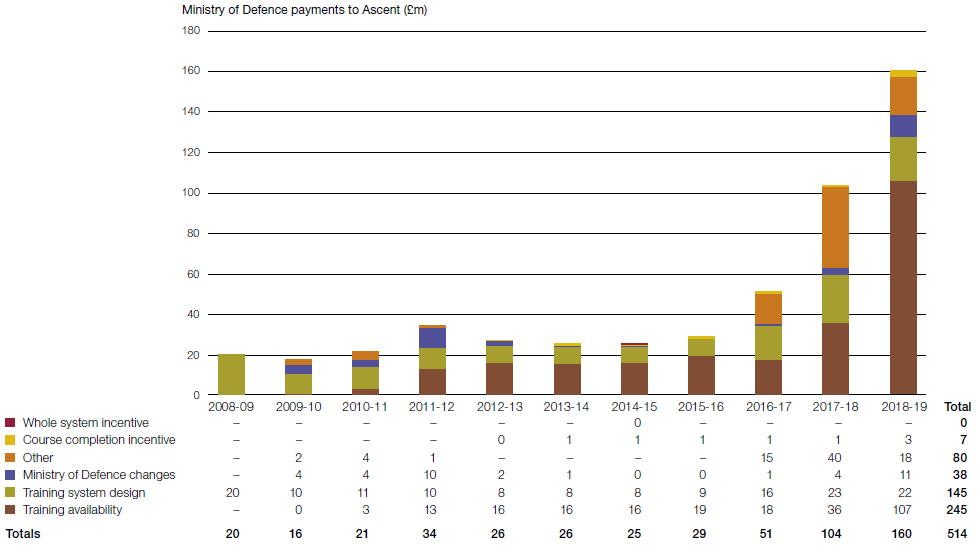
1.16 The Department pays Ascent for designing the Phase 2 training, introducing the system and managing availability. In 2015, the Department had forecast the MFTS would cost £3.2 billion over the 25-year contract. From the start of the 2008 contract to 2018-19, Ascent had received £514 million from the Department (Figure 6). In 2018-19, it received £107 million for ensuring training courses were available, with the required aircraft, simulators and instructors in place for each course. This is almost three times the £36 million Ascent received in 2017-18, which reflects, in part, that more MFTS courses are being provided.
1.17 To introduce and provide courses, both the Department and Ascent must fulfill their respective responsibilities. These include providing course materials, simulators, aircraft, instructors and airfeld services, and managing student numbers. Part Two of this report describes the performance of the Department and Ascent in fulfilling these responsibilities.
1.18 The Department contracted Ascent to meet the 2010 Review requirements through the MFTS. Subsequent changes made as a result of the 2015 Review mean the MFTS does not meet the Department's current requirements. For example, in 2018-19 it expected to train 76 fewer aircrew within Phase 2 than the current requirement of 342 students. Part Three of this report describes how the Department plans to meet these increased requirements.
____________________________________________________________________________________________
Figure 6
Payments received by Ascent Flight Training (Management) Limited from the Ministry of Defence (the Department), 2008-09 to 2018-19
Ascent has been paid more as it starts to deliver more courses
Notes
1 Figures presented on an accruals basis.
2 Figures include debt repayments for fast-jet and fixed-wing training private finance initiatives. They do not include more than £400 million of Departmental capital repayments direct to sub-contractors for aircraft and other infrastructure to support delivery of training.
3 Figures do not sum due to rounding. A hyphen shows no payment made. A figure of 0 represents less than £0.5 million.
Source: National Audit Office analysis of Ascent data
____________________________________________________________________________________________
______________________________________________________________________
8 Comptroller & Auditor General, Ministry of Defence, Training new pilots, Session 1999-2000, HC 880, National Audit Office, September 2000.