Introducing the MFTS
2.3 In 2015, we reported on the challenges the Department and Ascent had experienced introducing the new Phase 2 training, which led to a delay of nearly six years. The Department had originally expected to run the MFTS from 2012 and for it to be at full capacity, providing aircrew requirements set out in the Strategic Defence and Security Review 2010, by 2014. Delays resulted from the Department having to change its original assumptions about the 25-year contract following:
• substantial reductions in the number of aircrew entering training each year, and a decrease in overall funding from £6.8 billion to £3.2 billion, which led to changes to aircraft and training material; and
• changes to private finance initiative (PFI) accounting rules that meant the Department no longer used PFI to obtain aircraft and had to consider what it could afford.
____________________________________________________________________________________________
Figure 7
Summary of the roles and responsibilities of the Ministry of Defence (the Department) and Ascent Flight Training (Management) Limited, July 2019
The Department and Ascent need to manage dependencies for the Military Flying Training System (MFTS) to work
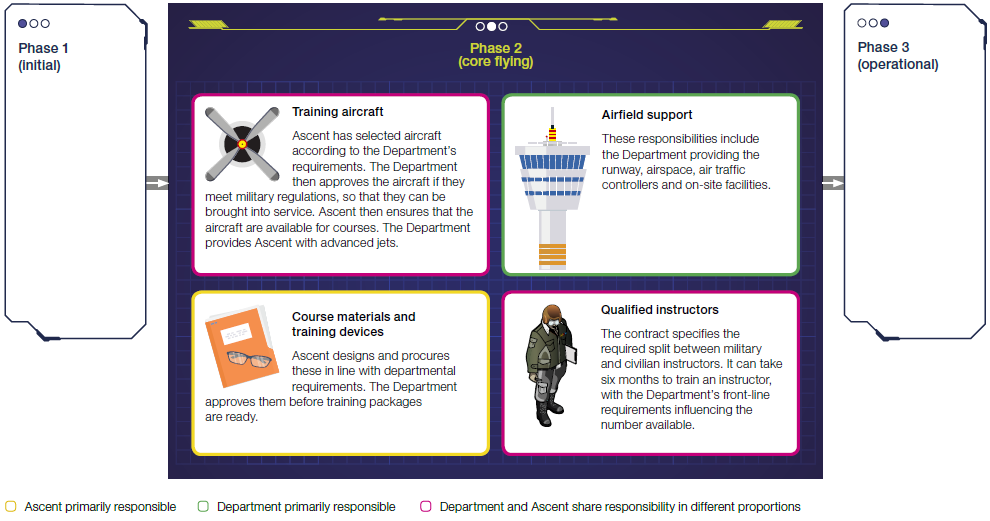
Notes
1 Figure shows the most significant dependencies. Ascent also depends on the Department for fuel, aircrew equipment assemblies and meteorological information. It is responsible for planning and scheduling training.
2 The respective responsibilities of the Department and Ascent differ depending on the aircraft type and the training site.
Source: National Audit Office analysis of Ministry of Defence information
____________________________________________________________________________________________
2.4 The Department and Ascent currently expect the MFTS to operate at full capacity from April 2020. This is only three months later than when we last reported in 2015. The Department considers this is a good outcome considering the past position of the programme. To meet this date, they expect to have the training equipment in place by December 2019 (Figure 8). They already have in place most of the required infrastructure, aircraft and simulators (Figure 9 on page 24). This includes new facilities on five training sites; 102 new aircraft (of seven types); around 20 flight simulators and other training devices; and 36 (out of 67 planned) designed and certified training courses. Ascent starts to receive availability payments once training courses are ready. As at July 2019, these payments had started for rear crew and advanced jet training, with 94% of the milestones for helicopter and fixed-wing training payments also being reached.9
2.5 In introducing the MFTS, both the Department and Ascent have experienced challenges fulfilling their respective responsibilities, which we describe below. Up to 2018-19, 25 introduction milestones were missed for helicopter and fixed-wing training. Ascent had initially foregone an estimated £15 million of expected payments due to these delays. However, the Department remained liable to pay £10 million of this where it had failed to fulfill its responsibilities or was contractually obliged to make payments.
______________________________________________________________________
9 The fixed-wing training package includes elementary flying and multi-engine training, which have been fully introduced, and basic jet training, which the Department and Ascent expect to be ready for training use from November 2019.