1. Introduction
PPPs are used to deliver public services in many countries including the United Kingdom, South Africa, Australia, France, Canada, the United States of America, South Korea, Ireland, Portugal, etc. With Governments across the world inclined towards development through the PPP framework, it is useful to understand PPPs
India's economy is steadily growing following steps toward economic liberalisation made in 1991. The Twelfth Five Year Plan (2012-2017) proposes to have a major thrust on infrastructure development in the country, with a planned expenditure of $1 trillion on infrastructure in this period.
| This level of growth requires rapid improvements and additions to the capacity of economic infrastructure. However, the ability of infrastructure to keep up with the economy's fast expansion has been constrained by the availability of investment. As a means to overcome this challenge, the Government of India initiated a strategy for encouraging private investment in the development of public services, especially in the infrastructure sector, through Public Private Partnerships (PPP). |
|
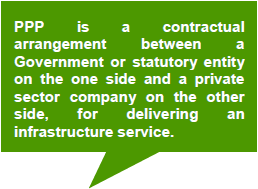
| Understanding Public Private Partnerships includes: • Definition of PPPs • Essential conditions - What is a PPP and what is not? • Merits and demerits • PPP Models • Interest of public entity and private partner in PPPs • Myths and Facts about PPP |