4.2. Options Analysis
The next step is to evaluate the most viable option after identifying and examining the advantages and disadvantages of each option and the risks and benefits to the Government from each option. The data typically used in options analysis include:
1. Demand and cost projections
2. Estimation of Life Cycle Costs (concept, development concept or preliminary design estimates)
3. Service delivery models and performance requirements
4. Technical information, for example, locality plans, topographical and geological data
5. Permits/consents/approvals
6. Site characteristics and constraints
7. Any revenue expectations
8. Suitability, performance/condition of any relevant existing infrastructure
A pre-feasibility analysis of the project can be used as a tool for evaluating the options and deciding which one is best. The objective of a pre-feasibility study is to provide first-hand information on the feasibility, at first sight, of a project and the optimal manner of implementing it. The indicative content of a pre-feasibility study report is set out in the diagram below:
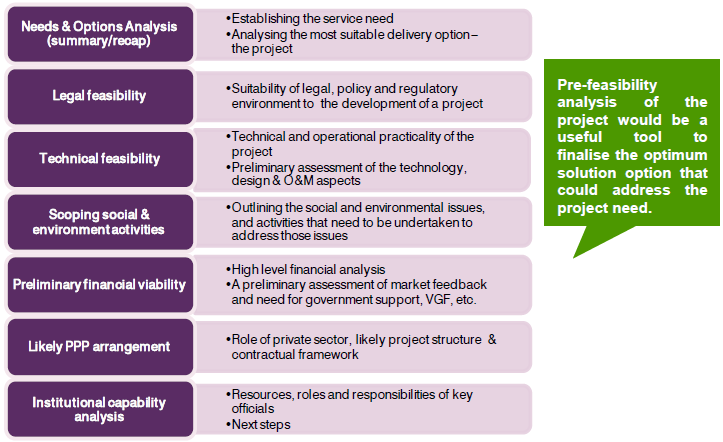
When the best option has been identified, it must be supported by data and arguments. At this stage, whether the project can be developed through a PPP framework cannot be assessed; this can only be determined later when the financial feasibility analysis and Value for Proposition analysis for the project have been carried out.