2.6. Inputs to Bidding Documents
The outputs of the technical feasibility study serve as an important input to finalize the bidding documents. Bidding documents typically consist of the Request for Qualification (RFQ), Request for Proposal (RFP), Draft Concession Agreement (DCA) and Project Information Memorandum (PIM). There are a few other variants of bidding documents which are used on the basis of project need. (Please refer to the Module no. 14 on Bid Documents and Other Project Documents for details.)
The information required in each of the bidding documents that emerge from the technical feasibility studies are explained in the diagram below.
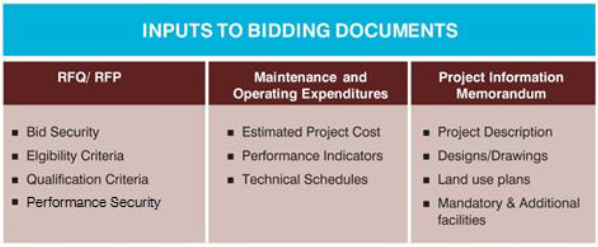
1. Request for Qualification and Request for Proposal: The value of the bid security and performance security are derived as percentage of the estimated project cost. Estimated project cost also serves as one of the factors in determining other conditions of the bidding document such as eligibility criteria and qualification criteria pertaining to the technical capacity and financial capacity of a bidder.
2. Project Information Memorandum (PIM): PIM provides information about the project and is part of a bidding document. Model RFQ & Model RFP issued by the Ministry of Finance, Government of India (GoI) provides for the public entity to insert either an information memorandum or a project report/feasibility report as part of the documents for bidders' information. The contents of the PIM are generated from the technical feasibility study report.
| Indicative Components of PIM What generally goes into a PIM? • General description of the project and project site • Key issues and concerns in the project • Brief market assessment study What does not generally feature in a PIM? • Financial viability analysis of the project • Economic viability analysis of the project Note: Contents of PIM could vary with the sector and the project. |
3. Draft Concession Agreement and Schedules: In addition to information provided in the PIM, the technical feasibility study also provides details regarding the project site, development and construction requirements, etc. which is included in the agreement to be executed with the selected bidder.
| Schedules in the DCA of an urban rail system would include the following heads: • Site of the project • Development of the Rail System • Project Facilities • Specification and standards • Applicable Permits • Performance Security • Project Completion Schedule • Drawings • Tests • Completion Certificate • Maintenance Requirements • Safety Requirements • Monthly Fare Statement • Passenger Charter • Traffic sampling • Selection of Independent Engineer • Terms of Reference of Independent Engineer • Fare Notification • Escrow Agreement • Panel of Chartered Accountants • Vesting Certificate • Substitution Agreement • Shareholders' Agreement It may be observed that most of these schedules are derived from the technical feasibility studies. |
4. Key Performance Indicators: The clauses on minimum service levels or key performance indicators that feature in the agreement are largely determined from the technical studies. For example, the design capacity of the road in a road project and the service level benchmarks pertaining to reduction in non-revenue water, continuous water supply, etc. in a water supply project are derived from the technical studies.
| Typical Performance Indicators 1. In power projects: • Generation - Plant Load Factor, normative availability for generating station - 85% • Transmission - Transmission losses • Distribution - Aggregate technical and commercial losses 2. In bulk water supply projects: • Permissible losses in storage of water - 1.5% • Permissible losses in transmission of raw water from abstraction area to water treatment facility - 2% • Permissible losses during the treatment of raw water at the water treatment facility - 2% • Permissible losses during transmission of treated water from water treatment facility to the water storage reservoir - 3% • Supply of treated water not as per prescribed quality - penalty • Delay in recording meter readings and entry in computerised billing system - penalty • Sale of treated water without due authorisation of the public entity - penalty • Failure to deposit consumer payments in the designated bank(s) within the stipulated period of time from the payment due date - penalty |