4. Formulation of Reasonable and Realistic Assumptions
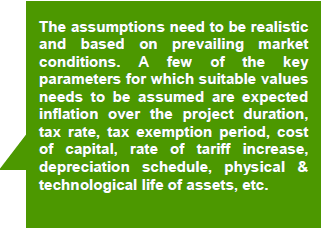
Assumptions are baseline data that apply throughout and are often the drivers in a business or financial model. It is always useful to organise the assumptions into logical groups. Indicative categories of assumptions are general assumptions, financing assumptions, tax assumptions, cost and revenue assumptions and market-related assumptions.
| Formulating Reasonable Assumptions - Key to Financial Feasiblity In corporate finance, the financial health/performance of a company is determined by its balance sheet, cash flow statements and the profit and loss accounts, all of which are prepared based on its past performance. In a PPP project, project finance is determined based on the project company's cash flow statements, balance sheet as well as profit and loss accounts, all of which are prepared on the basis of expected future performance for each year of the PPP arrangement. |
Other studies such as technical feasibility study, market assessment study, willingness to pay study, etc. carried out for the project, provide the basis for the assumptions made to assess the project's financial feasibility. For instance, a market study for the project provides the demand estimation. The technical feasibility study provides the cost related assumptions such as base construction cost estimates; O&M cost estimates, etc.
| Types of Assumptions - Indicative List 1. General Assumptions - output of project structuring activities/prevailing regulation/policy/practices/regulation/technical studies • Type of PPP arrangement • Operating framework - key obligations of parties • Duration of the proposed PPP arrangement • Escalation • Contingency • Technology option • Alignment option • Project life 2. Financing Assumptions - based on prevailing regulations/practices/legislation • Cost of equity • Cost of debt • Duration of debt • Repayment schedule • Moratorium period 3. Tax Assumptions - based on prevailing regulations/practices/legislation • MAT • Corporation tax • Tax exemption tenure 4. Cost Assumptions - based on technical studies • Base Construction Cost • Phasing of costs • O&M Costs 5. Revenue Assumptions - based on technical studies • Demand for the product/service to be delivered by the proposed project 6. Market related assumptions - outcome of market studies • Product mix for development • Land use for development |
Making justified and reasonable assumptions is the key to arriving at a credible financial feasibility assessment for the project. There may be certain assumptions that are mandated by the existing regulatory and legislative framework for the project such as the prevailing corporate tax rate, escalation rate (based on WPI index in the past ten years), etc.
| Sometimes, the public entity seeking the preparation of feasibility studies prescribes the use of certain assumptions. In such cases, the assumptions need to be used with an element of caution. For instance, in case of development of roads under PPP framework; to be eligible for Financial Support to PPPs in Infrastructure (under the VGF Scheme); the growth rate in traffic year on year is to be assumed at 5 per cent; which may not be the actual case. Also, in development of ports, the Tariff Authority for Major Ports (TAMP) allows only up to 16 per cent return on capital investment to the private partner which makes other assumptions in the development of port to be determined by reverse calculation. |
|
| Key Assumptions in Financial Feasibility - Development of Roads under DBFOT basis In a typical road project to be developed on a DBFOT basis, indicative assumptions that are required to undertake the financial feasibility assessment are given below. • General Assumptions - number of toll plazas, number of lanes, operating framework - whether annuity/toll, scope of services to be delivered by the developer, etc. • Tax Assumptions - Corporate tax, Minimum Alternative Tax • Cost Assumptions - base construction cost, annual maintenance per km, periodic maintenance per km, operations cost (manpower, medical aid, etc.), cost of maintenance of toll plazas, etc. • Revenue Assumptions - toll notification • Demand Assumptions - number of PCU counts • Financing Assumptions - Source of finance, cost of debt, cost of equity, debt to equity ratio, etc. |