Capital Markets - Bond Financing
| Bonds are common means of financing in corporate finance whereas the same as a means of financing in project financing is not very common. The commercial debt financing in project finance are offered under a floating rate with a medium-term maturity whereas, bond financing offer long-term maturity by institutional investors thus making it a better option of debt financing. Bond financing has certain potential disadvantages. For instance, it involves a single, up-front subscription and hence limits the ability to draw down funds as and when required. This also leads to increased capitalised interest charges. Unlike commercial lenders, bond investors lack sector knowledge and have no active involvement in project development. The traditional bond structure does not allow investors to react to changes in project development/operation. In developed economies, this disadvantage has been moderated by the entry of insurance companies, who offer a financial guarantee to investors. In such cases, the bondholder's exposure is transferred primarily to the balance sheet of the insurer. |
|
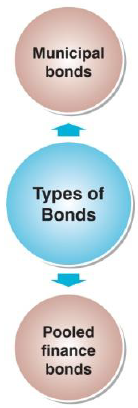
An example of bonds issued for project financing are those issued by Local Governments to fund projects in urban areas for better service delivery to their citizens. These are project-specific bonds. A few of the successful urban sector projects that have been financed through municipal bonds are the Ahmedabad Water Supply and Sewerage programme by the Ahmedabad Municipal Corporation and the Greater Bangalore water supply project by Karnataka Urban Water Sector Improvement Project (KUWASIP).
| In January 1998, the Ahmedabad Municipal Corporation issued municipal bonds for Rs.1000 million. The issue was designed to finance partially a Rs.4890 million water supply and sewerage programme. This was a remarkable achievement as it was the first municipal bond issue in India without a State Government guarantee and it represented the first step towards a fully market-based system of local Lfinance. The 75 per cent private and 25 per cent public issue, rated AA(SO) by Credit Rating Information Services of India Ltd. (CRISIL), (indicating a high degree of certainty about timely repayment) promoted a growing national consensus on municipal bonds being a promising alternative to fund urban infrastructure projects. What can we learn? • The municipal bond mechanism to raise finances for infrastructure projects can work in India. • Municipal corporations should get their bond issues rated by credit rating agencies to project the financial soundness of the bond issue to investors to mop up resources successfully through this route. • The local body must have detailed project proposals ready for implementation to ensure quick utilisation of funds. • All urban local bodies with a sound financial position, credibility and a sound track record, can go for municipal bonds to raise money for infrastructure development. |
The Government of India has set up a Pooled Finance Development Fund (PFDF) to provide credit enhancement to ULBs to access market borrowings based on their credit worthiness through a State-level pooled finance mechanism. This scheme improves the access of urban local bodies to capital markets for borrowings. The scheme is meant to provide credit enhancement grants to access market borrowings through Pooled Financing Bonds on behalf of identified ULBs for investment in urban infrastructure projects.