1. Introduction
Value proposition of project assessment plays a central role in decisions on investment prioritization, selection, and presentation of the choice of procurement approach. It is conducted in order to ascertain whether the project being developed through a PPP framework offers good value to the public entity and ultimately to the general public. The concept of value proposition of projects is similar to the Value for Money (VfM) assessment undertaken for projects as proposed in United Kingdom's, the HM Treasury Guide for VfM assessment.
| What does Value for Projects Analysis Answer? • Whether developing the project under a PPP framework results in any value to the public sector? • Whether the bid submitted by the preferred bidder is acceptable to the public entity thereby providing value to the public sector? • Whether or not to award the project to the preferred bidder? | |
| The analysis is undertaken to support key decisions and should be conducted even if no fiscal support is required - for example, if the costs may be recovered through user charges - as there is an obligation to ensure that the charges users pay are fair and reasonable. This is particularly relevant to annuity based payment schemes where a framework is needed to assess whether the right procurement route is being used given the alternative of more traditional procurement approaches. |
|
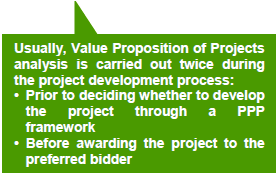
| The analysis is useful to decide whether to pursue the project under a PPP framework. On receipt of bids from the private partners, the results of value proposition analysis are useful for examining whether the winning bid delivers value to the public entity. A robust analysis can also be helpful in: 1. Optimizing the PPP structure and the underlying risk sharing arrangement - the analysis will help structure the PPP in terms of designing a risk allocation that is bankable, affordable, and provides value to the public entity. 2. Assessing the impact of changes in the risk sharing arrangement; and 3. Establishing an acceptability threshold for bids. |
|
However, there are various practical difficulties in ensuring the robustness of a value proposition of projects assessment, primarily relating to the calculation of realistic public sector comparator.