2.1. Initial Assessment
| An initial assessment is carried out as part of the project feasibility study, prior to in principle approval, to help the public entity determine the appropriate procurement strategy for the project before soliciting proposals from the private sector. The objective of this initial assessment is to provide an indication as to whether a PPP project is likely to provide value as compared with a project which is developed by way of traditional public procurement. Some of the key objectives of this assessment are to: 1. Demonstrate that the initial decision to develop the project through a PPP is based on a need and option analysis and is valid for the particular project; 2. Verify whether appropriate risk transfer arrangements are achievable; 3. Direct the public entity early on, where project specific issues emerge indicating that a PPP is no longer likely to offer value, towards the possibility of using other procurement routes including switching to conventional procurement; 4. Provide feedback to improve the evidence base and potential for market management; | |
| 5. Provide improved cost estimates so that, as part of the feasibility study, the contracting Authorities can be confident that the project is affordable; 6. Test whether the PPP solution option has sufficient market interest; 7. Help ensure an efficient bid process is planned within a realistic time frame; and 8. Provide the tender evaluation team with a framework within which they can take decisions if the assessment should suggest that the market conditions are unfavourable. |
|
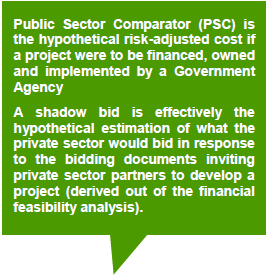
| Steps in Initial Value Proposition of Projects Test: 1. Calculate the Public Sector Comparator (PSC) for the project 2. Check whether the PSC is greater than the shadow bid 3. If the PSC is greater than the shadow bid, there is value in developing the project through a PPP framework | |