4. Public Sector Comparator
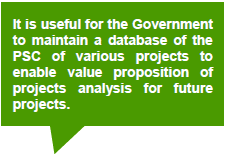
| An assessment of whether a PPP project offers value is an essential part of a PPP procurement process. To understand the costs of a traditional public-sector approach, Public Sector Comparator (PSC) is used as a means to compare and understand the value proposition of projects. Various Government bodies have come up with specific definitions for a PSC. A few of those definitions are as follows: |
|
The Government of Western Australia, Department of Treasury, defines PSC as:
The PSC is an estimate of the net present cost to Government if it was to deliver the project under a more traditional procurement method, for example design and construct.
The World Bank assisted presentation on "Public Sector Comparator for Highway PPP Projects" defines PSC as:
The PSC is the hypothetical risk-adjusted cost if a project were to be financed, owned and implemented by a Government Agency.
The PSC is developed in accordance with the required output specification, the proposed risk allocation and is based on the most efficient form and means of Government delivery.
| Purpose of PSC Public entities use the Comparator as a benchmark to help decide whether an alternative procurement method using private finance would offer better value to the public entity. Some of the key purposes of the PSC are: • Encouraging the Government Agency to calculate full cost pricing at the initial stage of the project development • Creating a uniform and consistent benchmark • Taking decisions on implementation through PPP by demonstrating value to the public entity |