3. B/C Ratio
This is the ratio between discounted economic benefits and costs.
| Formula for Calculation of ENPV and ERR: Economic net present value (ENPV): difference between the discounted total special benefits and costs.
Economic rate of return (ERR): is the discount rate that zeroes out the ENPV. It is compares with a benchmark in order to evaluate the project performance.
St is the balance of the cash flow (net economic benefit) at time 't' and 'a' is the discounting factor chosen for discounting at time 't'. |


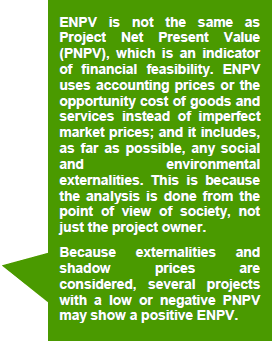
| ENPV and ERR give different types of information about a project. ENPV provides the criterion to decide whether the project should proceed at all (in general, a project with a negative ENPV would not be pursued). ERR allows a project to be compared against a required rate of return. It gives a yes or no answer about whether the project is economically viable. However, the ERR alone does not give enough information to say whether one project should be pursued ahead of another. This is a value comparison best suited to ENPV analysis. ENPV is the most important and reliable social cost-benefit analysis indicator. Although ERR and B/C are meaningful because they are independent of the project size, they may sometimes involve problems. In particular cases, for example, the ERR may have multiple values or may not be defined. |
|
In principle, every project with an ERR lower than the SDR or a negative ENPV must be rejected. A project with a negative economic return uses too much of socially valuable resources to achieve modest benefits for citizens.
| The table given below provides a sample from over 400 major projects completed in the European Union and their combined economic internal rates of return. These economic rates of return should not be viewed as benchmarks; they are merely illustrative of the kinds of returns that might be generated. | |||
| Sector/ Project | Economic Internal Rate of Return | ||
| Energy | 12.9 | ||
| Water & Environment | 15.8 | ||
| Transport | 17.1 | ||
| Industry | 18.4 | ||
| Other Services | 16.3 | ||
| Average | 16.8 | ||
| Source: EC Regional Policy "Guide to Cost Benefit Analysis of Major Projects" 2006 Edition As per the "Capacity Development of National Capital Region Planning Board (NCRPB) Package 1 (Components A and C); Project Appraisal Manual April 2009, by ADB; The minimum rate of return of around 12 per cent could be interpreted as economically viable taking into account benefits and costs. A general decision rule may include the following: 1. Accept all independent projects (any infrastructure investment projects) and subprojects with an EIRR of at least 12 per cent; 2. Review and reassess any independent projects and subprojects (non-infrastructure) with an EIRR between 10-12 per cent for which additional unvalued benefits can be demonstrated, and where these benefits are expected to exceed unvalued costs 3. First reassess and generally reject projects and subprojects with an EIRR below 10 per cent. | |||
The economic analysis report would ideally need to include the project background justifying the need for the project and its objectives, identifying the economic costs and benefits, and analysing the net economic benefit/cost of the project in terms of economic viability indicators. Annexure 8 to this module sets out indicative structure of an economic analysis report.