5.2. Completion Risks
| Completion risk refers to the completion of construction of project risks. It is also otherwise termed as construction risk. This is one of the most critical risks that need to be addressed in projects, especially in those that have traditionally experienced a high level of difficulty in completing construction. Completion risks would also have a repercussion on commissioning of a project and thus the commissioning risk. Commissioning risk is the risk associated with delay in the commencement of the commercial operations of the project. The nature of completion risks are described below: |
|
| • Ability to start the project within the budgeted time • Ability to complete the project within the budgeted costs • Adherence of the project assets to the specifications (including the quality standards) • Completion risks can delay the project and increase project costs very significantly | |
| Common reasons for time and cost overruns • Delays in the site being made available • Delays in supporting infrastructure • Delays in approvals • Design and engineering risks • Geo-technical risks: uncertain ground conditions • Construction technology • Availability of construction materials • Contractor's delays and failures • Delay in/ non-availability of labour | |
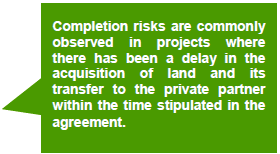
| Mitigation Measures • Assurances from the Government entity regarding delivery of land - either 100% or the bulk of it, with suitable penalties and comforts in the event of non-compliance • Other assurances -environmental clearance, statutory approvals, any other support infrastructure or activity (dredging of a channel, for instance, in a port project) - with suitable comforts in the event of non-compliance • Evaluate DPR - supply of key construction inputs - material, equipment and manpower in the vicinity of the project sites and costs of these inputs • Evaluate need for various components and specifications - extent of civil construction, access points, grade separators, drainage etc. • Completion Certificate by Independent Engineer - only after verification that project assets created are as specified and of desired quality • Other construction - in a railway over bridge - portion over rails - done by Railways or private partner • Incentive structure in the contract - bonuses, penalties and liquidated damages • Use of good quality planning techniques such as the critical path method, lean construction, building information modelling, etc. |
Significant cost overruns and delays in infrastructure projects in India are set out in the table below
| Sector | Number of Projects | % of Projects with Positive Cost Overrun | % of Projects with Positive Time Overrun |
| Road, Transport and Highways | 157 | 54.14% | 85.35% |
| Railways | 122 | 82.79% | 98.36% |
| Shipping and Ports | 61 | 31.15% | 95.08% |
| Urban Development | 24 | 41.67% | 100.00% |
| Civil Aviation | 47 | 42.55% | 91.49% |
| Health and Family Welfare | 2 | 100.00% | 100.00% |
Source: Adapted from article in the Economic & Political Weekly, May 22, 2010. (Delays and Cost Overruns in Infrastructure Projects: Extent, Causes and Remedies, by Ram Singh, DSE)