3.2. Scope of PPP
The scope of the PPP project is defined in terms of tasks and responsibilities transferred to the private entity. Tasks and responsibilities are related to the different project components that are to be designed, built, financed, maintained and operated. It is to be noted that the scope of the PPP project does not have to be the same as the scope of the overall project identified for the purpose of meeting a specific public objective.
For example, the scope of the PPP project can be less than the scope of the overall project i.e. excluding certain tasks and responsibilities, because it is more attractive or more achievable, in other words splitting up the project.
The scope of the PPP project can be larger than the scope of the overall project also, i.e., adding certain tasks and responsibilities because it is more attractive or more achievable in cases where the land development rights or advertisement rights are transferred to the private partner in addition to the original project.
The matrix shown below helps to visualise the scope of the project discussed in the case above. The rows indicate the different project components that the scope of the project comprises and the columns indicate the key tasks related to the different project components for the purpose of providing a specific public service.
| Project components | Design | Build | Finance | Maintain | Operate |
| Road A-B |
|
|
|
|
|
| Road B-C |
|
|
|
|
|
| Rest Areas |
|
|
|
|
|
| Fuel Stations |
|
|
|
|
|
| Road side Infrastructure |
|
|
|
|
|
Applying the scope matrix to a road project implies that first;
1. Different project components are identified, e.g.
a. Different road sections;
b. Who will get the responsibility to develop rest areas?
c. Who will get the responsibility to develop fuel stations?
d. Roadside Infrastructure
e. Public entities can also think of respective civil works like tunnels and or bridges
2. Each of these assets may have to be
a. Designed
b. Built
c. Financed
d. Maintained, and
e. Operated
It is usually advised to start with the assumption of an integrated BOT project. The rationale for this is that all the interface risks are transferred to the private partner, who could be more incentivized to manage this risk. Also it means that the public sector risk exposure is reduced.
Sample risk matrix for integrated BOT is set out in the table below.
| Project components | Design | Build | Finance | Maintain | Operate | |
| Road A-B |
| |||||
| Road B-C | ||||||
| Rest Areas | ||||||
| Fuel Stations | ||||||
| Road side Infrastructure | ||||||
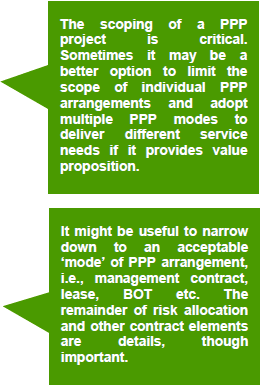
| However, in practice, it may well be that such a BOT is not viable or attractive and that the project needs to be split up in different contractual arrangements. These contractual arrangements may not all have to be BOT and they can be different PPP modes. Sometimes, it may be more viable and more attractive to apply different contractual arrangements for the different elements. However, it will all depend on the financial analysis and the value proposition analysis. A critical element in the scope of the project relates to so-called interface risks. In principle each element of the scope depends on another element. For example if road A to B is not ready, demand on road B to C will be impacted. If road B to C is not ready, it does not make sense to operate rest areas. In selecting a multiple contract structure for achieving the overall project objective, additional agreements or contracts will be needed to define the interaction between the various elements and specifically allocate responsibilities for resolving interparty issues. |
| |||||
A sample of combination of PPP modes is set out in the diagram given below:
| Project components | Design | Build | Finance | Maintain | Operate |
| Road A-B |
| ||||
| Road B-C |
|
| |||
| Rest Areas |
| ||||
| Fuel Stations |
| ||||
| Road side Infrastructure |
| ||||
The challenge is to define who will manage these interface risks; - Will it be the public entity which is the case when different contractual arrangements are applied, or, Will it be the private partner which is the case when an integrated BOT is applied.