1. Introduction
The increasing complexities in projects coupled with governance exigencies has made it paramount for the procurement process to be carried out in a fair and transparent manner. The contours of the procurement process typically need to be finalised during the project structuring stage and the actual process for selection of a private partner starts only after the project structuring exercise is completed and the administrative approvals have been obtained.
Procurement processes are governed by the business and financial rules that need to be adhered to by the public entity. A transparent, fair and competent procurement process would go a long way in establishing the project's credentials and building trust in a PPP project.
| Objectives of Procurement Process • To lower cost associated with the selection of a private partner • To provide fair opportunities to eligible participants to compete • To bring transparency and legal certainty to procurement • To optimise delivery of public services • To ensure efficient allocation and use of public funds |
| The procurement process is preceded by the project structuring stage and is followed by the post award contract management stage. The procurement process involves preparation of bid documents depending upon project specifics and the process for selection of a private partner for the project. This stage culminates in the issue of a Letter of Award (LoA) to the private partner. The public entity, prior to starting the procurement process, needs to ensure that the following matters are ascertained and/or the following exercises are undertaken with respect to a given project. |
|
• Technical feasibility, financial feasibility and test for legal compliance of the project is complete;
• Project assumptions have been discussed and finalised;
• Risks and responsibilities have been identified and allocated;
• Critical issues have been identified and addressed;
• Project delivers value proposition, i.e., efficient and cost-effective delivery of services;
• Project is bankable;
• Public entity initiating the process has power to award the project;
• Public entity has an encumbrance-free title over the land/project asset or atleast is committed and takes necessary steps in this regard to make the land free of encumbrances available in a timely manner for project development;
• Funding sources have been identified; and
• Appropriate administrative approvals have been obtained
Once these basic pre-requisites for the procurement process have been fulfilled, the next step is to choose a procurement strategy. To ensure the success of any PPP project, it is critical that a transparent strategy suitable for the type of contract is selected. The procurement strategy or bid structure that is adopted must be transparent, open, competitive, free, fair, as well as cost and time effective. The key principles that govern the procurement process are set out below:
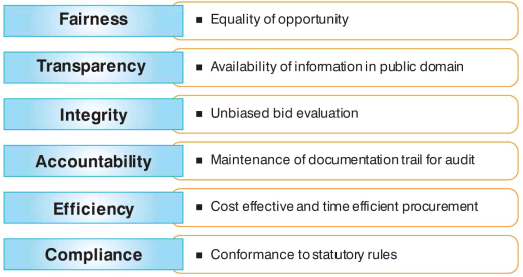
The public entity must always strive to ensure that the procurement process adopted for any project/service delivery is fair, transparent, unbiased, brings in accountability, efficiency, and is compliant with the legal and regulatory framework of the country.
| Procurement Guidelines by Chief Vigilance Commission & Other State Governments • The Central Vigilance Commission (CVC), Government of India from time to time has issued guidelines and circulars that govern public procurement of goods and services. In line with the CVC guidelines, several State such as Karnataka, Gujarat, Uttarakhand, etc. have also issued procurement laws, rules and guidelines that govern public procurement in respective States. It is imperative that the public entity must comply with CVC guidelines and State specific procurement laws/ guidelines, if any; for public procurement. All CVC guidelines for public procurement of goods, works and services are available for download in the link: http://cvc.nic.in/proc_works.htm • Since, the inception of CVC in the year 1964, its Technical Wing namely Chief Technical Examiner's (CTE) Organisation as has been discharging its duties in the form of intensive examination of public procurement contracts, under the guidance of CVC. The Organisation has also published guidelines on intensive examination being carried out by CTE's Organisation in the form of a booklet titled 'Intensive Examination of Works' (Guidelines). In 2014, revised Guidelines on Intensive Examination of Procurement and Other Contracts was published for the benefit of public entities. • CVC Act 2003 empowers the Commission to call for reports, returns and statements from all Ministries/ Departments/Corporations/Central Undertakings so as to enable the Commission to exercise general check and supervision over the vigilance and anti-corruption work in the Ministries/Departments/ Undertakings. Chief Vigilance Officers of various organisations covered under the jurisdiction of the Commission are required to furnish Quarterly Progress Reports (QPRs) in respect of ongoing contracts for the quarter by 15th day of the month following the quarter. Even though, CTE's Organisation may examine Contracts of any magnitude, yet considering limitation of resources, it generally undertakes examination of Contracts of larger value only. Circular No. 15/07/12 (issued vide Letter No.98-VGL-25/18 dated 30.07.2012), states the monetary limit for reporting the Procurement Contracts with in QPRs. It states that any PPP procurement, the monetary limit (cost/ revenue value) of which is Rs.5 Crores or above need to be mentioned a part of QPR. |